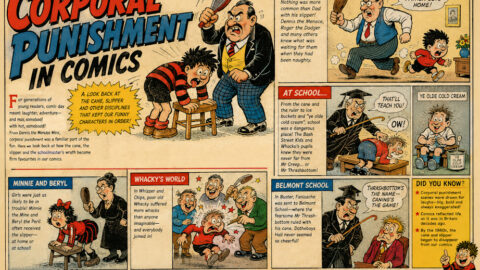
As early as the 1870s, corporal punishment had its detractors. The Government sought to restrict its use within the state education system, yet Scotch maintained that such measures would undermine the authority of teachers. Alternative forms of discipline, such as detention after school hours, were regarded with equal suspicion. One school authority argued that depriving boys of outdoor exercise was “far more injurious to health, and consequently more truly cruel than a few strokes of a strap or cane.” Indeed, it was asserted that “the old Scottish tawse was the most humane means ever employed in school government.”
William Littlejohn, the Principal, was remembered as a man who “caned seldom and with reluctance, and was notably lenient towards maladjusted boys threatened with expulsion.”
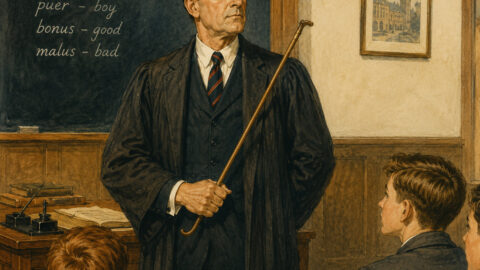
The privileges of the prefects included their common room, their badges of office, and exemption from ordinary punishments and detentions. More significantly, however, they exercised authority over their fellow pupils. In formal Prefects’ Meetings they adjudicated disciplinary matters and imposed penalties. The School Captain presided and administered strokes of the cane where required. Lesser punishments included warnings and detentions. Although appeals to the Principal were permitted, they were rare, and the decisions of the prefects were generally upheld.
Prefects’ Meetings continued until approximately 1970. During that period they dealt with offences such as smoking, swearing, leaving the school grounds during school hours, and breaches of uniform regulations. By the 1930s, disciplinary authority had extended into academic matters, with boys punished for copying work or permitting others to do so. Even offences committed beyond the school grounds could attract punishment. Boys were caned for smoking in private clothes, in their own homes, or at country railway stations. A boy of Scotch remained subject to school discipline wherever he might be, and the notion of a private life scarcely existed.
One former prefect later reflected:
“Given our inexperience, I believe the Prefects’ Meetings were conducted in a fair and reasonably balanced manner, though there was naturally an assumption that a boy brought before us was probably guilty. Where guilt was established, the penalty was discussed collectively before sentence was pronounced.”
By 1956, a curious ritual had developed in which prefects silently awarded marks out of ten for the severity or effectiveness of each stroke administered with the cane. One former pupil recalled “the whistle of the cane and the sharp pain of the first stroke. The second was felt distinctly also, but thereafter the pain dulled the remainder.” Another incident, involving Brian Taylor, School Captain in 1928, became part of school legend: when caning a boy for smoking, the offender’s trousers reportedly caught fire after matches in his pocket ignited.
Leadership at Scotch, it was often said, meant enforcing discipline. It also entailed asserting the authority of the prefects themselves, and boys who challenged that authority were at times punished solely for their defiance.
Yet some observers maintained that, despite their ready use of corporal punishment, nineteenth-century schoolmasters were in certain respects gentler and more affectionate towards their pupils than many of their twentieth-century successors.
David Pennington later remarked succinctly: “Caning by senior boys was customary. I avoided it through careful conduct.”
By the 1930s the school had become increasingly self-contained and closely regulated. Boys were caned for leaving the grounds during school hours, whereas in earlier decades pupils at Eastern Hill had taken luncheon in the city and frequented its arcades with relative freedom.
Former pupils of the 1950s recalled a rigid disciplinary atmosphere. One remembered witnessing a fifteen-year-old boy being caned on the bare buttocks by an eighteen-year-old prefect. The punishment, six strokes in number, was administered with such force that the skin was broken and bruising remained visible for several weeks. The offence, according to the account, was merely that the boy had telephoned home from a public telephone box. The experience reportedly left him embittered for many years.
In boarding houses, insufficient adult supervision occasionally allowed prefects to develop personal animosities, repeatedly targeting certain younger boys. This in turn bred resentment, leading to further punishment for insubordination. An ordinary pupil might be caned six or ten times during his school career, while others endured dozens of such punishments. For boys accustomed at home only to mild reprimands, the severity of caning came as a profound shock. One former pupil, David Brand, later produced coloured illustrations showing the bruises as they darkened and faded over a period of weeks.
New masters were not exempt from schoolboy mischief. One housemaster, Mr Thompson, was welcomed by having his bed “short-sheeted” and toothpaste liberally applied about his quarters. Another master, known as “Bunny” Lappin, was said to have “almost worn out his cane punishing both the innocent and the guilty alike.”
Particularly striking was the severity with which smoking offences were treated. Between at least 1936 and 1971, School Captains commonly imposed four to six strokes of the cane for smoking. It mattered little whether the offence occurred away from school grounds, out of uniform, or even with parental consent. In one instance during 1964, a boy received three strokes merely for carrying cigarettes. Such punishments were often more severe than those imposed for theft, dishonesty, bullying, or even bringing explosives onto school premises.
Card-playing and gambling were similarly condemned, despite evidence that such activities remained widespread among the boys. In 1961, one pupil was caned for offences that included gambling.
By the early 1960s, school authorities remained firmly committed to strict discipline. Boys were reminded that they remained subject to school authority not merely on campus but everywhere outside their own homes, regardless of whether they wore school uniform. Public school head prefects asserted the right to regulate smoking and drinking even at private social gatherings.
In 1963, a fifth-form boy was caned for smoking away from the school while out of uniform. Throughout the early 1960s, smoking remained the most common reason for caning, with four strokes the usual penalty. Repeat offenders could expect six strokes and stern lectures on the standards and expectations of school life, in the hope that they might, as the authorities put it, “be brought around to our way of thinking.”