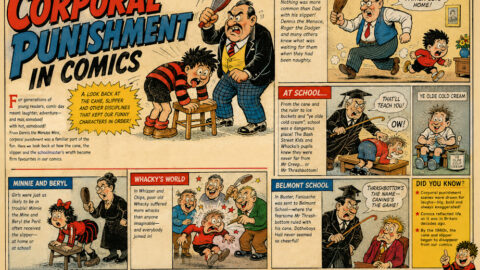
Not all corporal punishment resulted from obvious misconduct such as fighting, smoking or truancy. The survey shows that pupils could also be punished for matters connected directly with their schoolwork.
These included repeatedly failing to complete homework, producing work considered careless, and cheating in examinations or tests.
The distinction between discipline and academic performance was therefore not always clear.
Failure to Complete Homework
Repeatedly missing homework could be regarded as deliberate disobedience rather than academic weakness.
One grammar-school boy recalled being punished in 1964, at the age of thirteen, after repeatedly failing to complete homework.
He had already attracted the attention of his classroom teacher and was sent outside. While there, he encountered the senior mistress, who took responsibility for the matter.
The result was a formal punishment in her office.
The boy later stated that he did not repeat the offence and considered the punishment effective.
What is important here is the word repeated.
The punishment was not simply imposed because a pupil had forgotten one piece of homework. The account suggests that earlier failures had already occurred and that the school regarded the matter as persistent disobedience.
Poor Work
More difficult is the question of punishment for the standard of work itself.
One thirteen-year-old boy recalled receiving four strokes in 1959 because his work was considered unsatisfactory.
He stated that teachers at the school did not normally use the cane in this manner, which made the occasion particularly memorable.
He subsequently took greater care with his work.
According to his own assessment, therefore, the punishment was effective.
Yet the example raises an obvious difficulty.
Poor work may result from laziness, but it can equally result from lack of understanding or ability.
The survey rarely provides enough information to determine which explanation applied.
Cheating
Cheating was different.
Schools could regard it as an offence against honesty rather than merely an academic failing.
One grammar-school pupil caught cheating during a Latin test in 1965 was instructed to collect both the cane and punishment book.
He received four strokes from his teacher.
Afterwards he had to return the cane and book to the school office before proceeding to his next lesson.
He stated that he never repeated the offence.
When the Accusation Was Disputed
Another contributor remembered a very different experience.
At the age of sixteen he was accused of copying another boy’s work.
He maintained that the other boy had copied from him.
Neither the teacher nor the headmaster accepted his explanation, and punishment followed.
Many years later he still regarded the punishment as ineffective because, in his view, he had been innocent.
His parents believed his version of events and complained to the school.
The contrast between these two cheating cases is instructive.
In the first, the pupil accepted responsibility and considered the punishment effective.
In the second, the pupil rejected the accusation and therefore rejected the punishment.
Academic Discipline
These examples show that corporal punishment was sometimes used not merely to maintain silence or prevent fighting, but to enforce academic expectations.
Homework had to be completed.
Tests had to be honest.
Work had to reach an acceptable standard.
Whether corporal punishment was an appropriate means of achieving these objectives was debated even among those who otherwise supported firm discipline.
The survey cannot settle that argument.
What it can demonstrate is that the boundary between education and discipline was sometimes remarkably narrow.