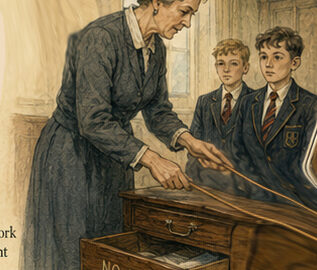
Certain numbers recur throughout recollections of corporal punishment.
Of these, six possesses particular significance.
“Six of the best” became a familiar expression because six strokes frequently represented a substantial school punishment.
A Recognised Maximum
In some schools six appears to have operated as the normal upper limit for an individual formal punishment.
This was not universal, and the survey contains exceptions.
Nevertheless, the frequency with which six occurs suggests that pupils often understood it to mean that an offence had been treated seriously.
Age and Escalation
One respondent remembered receiving smaller punishments when younger.
The number increased as he grew older, eventually reaching six at about fifteen.
This suggests a system in which severity could rise with age.
Again, the account should not be transformed into a national rule.
It represents one pupil’s experience.
Six Did Not Mean the Same Thing Everywhere
The implement also mattered.
Six strokes with a slipper and six with a cane were not necessarily regarded by pupils as equivalent.
Respondents who experienced more than one method frequently distinguished between them.
The survey therefore cannot simply total the number of strokes and compare punishments numerically.
Symbolic Importance
Six nevertheless possessed symbolic importance.
A pupil told that he was to receive six understood that the matter was serious.
The phrase itself entered school vocabulary.
It could circulate among pupils even where relatively few actually experienced such a punishment.
The Danger of Folklore
Here, however, the historian must again exercise caution.
School folklore tends to concentrate upon dramatic punishments.
Stories of severe canings are more likely to be repeated than stories of a single stroke for talking.
The dramatic event therefore occupies more space in memory than its statistical frequency might justify.
Ordinary Punishment Was Often Smaller
The survey contains numerous examples of one, two, three and four strokes.
These lesser punishments may provide a better picture of everyday discipline than the famous “six of the best.”
The spectacular punishment attracts attention.
The ordinary punishment tells us how the system functioned from day to day.
A balanced history requires both.