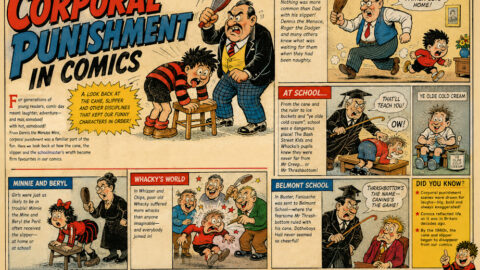
Every disciplinary system eventually encounters the pupil who repeatedly breaks the rules.
Corporal punishment was no exception.
Some contributors remember only one school punishment.
Others remember several.
A smaller number describe themselves as regular recipients of the cane or slipper.
Their experiences are particularly important when considering effectiveness.
One Punishment Was Enough
For some children a single encounter produced the intended result.
The boy slippered for talking during silent work did not repeat the offence.
The pupil caned for poor work became more careful.
Others punished for fighting, smoking or running in corridors similarly reported avoiding that particular offence afterwards.
These are straightforward examples of deterrence.
Punished Again—but for Something Else
More complicated are the pupils who never repeated the original offence but were subsequently punished for something different.
One grammar-school boy’s record illustrates this particularly clearly.
He was punished for talking.
Later he was punished for running in a corridor.
Later still came punishment for homework offences, cheating, fighting and misbehaviour during assembly.
Asked separately about the individual incidents, he regarded many of the punishments as effective because he did not repeat the particular offence.
Yet taken as a whole, the record shows that corporal punishment did not turn him into an entirely obedient pupil.
Both statements can be true.
Familiarity
Repeated punishment could also remove the fear of the unknown.
One contributor recalled that before his first punishment he had maintained a high standard of behaviour partly because he wished to avoid corporal punishment.
Once he had experienced it, his attitude changed.
He knew what the punishment involved and discovered that he could endure it.
He subsequently became a more regular recipient.
This is a striking example of punishment producing an unintended consequence.
The Regular Slippering
The slipper appears particularly associated with repeated minor punishment.
A pupil might receive it several times during a school career without ever appearing in the official punishment book.
Some contributors specifically state that they have not attempted to list all their slipperings because there were too many to remember individually.
This suggests that in certain schools the slipper occupied a position somewhere between formal punishment and ordinary classroom management.
The Problem for the Teacher
A repeat offender presented the teacher with an obvious problem.
If three strokes had failed, should the next punishment be four?
If the slipper no longer deterred, should the cane be substituted?
At what point did increasing severity cease to serve any useful purpose?
The survey does not provide the teachers’ answers.
It records principally the experiences of former pupils.
Nevertheless, the pattern is visible.
Some children responded strongly to the first punishment.
Others became accustomed to it.
Punishment and Personality
This suggests that effectiveness depended partly upon personality.
A naturally cautious child might find the possibility of being sent to the headmaster terrifying.
A more rebellious pupil might regard the same risk as worth taking.
A third might obey teachers but misbehave when surrounded by friends.
No single punishment could be expected to affect every personality identically.
The repeat offender therefore provides one of the strongest warnings against treating corporal punishment as a mechanical process.
Children were not machines.
The same input did not always produce the same result.