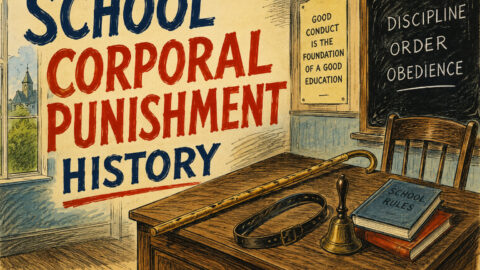
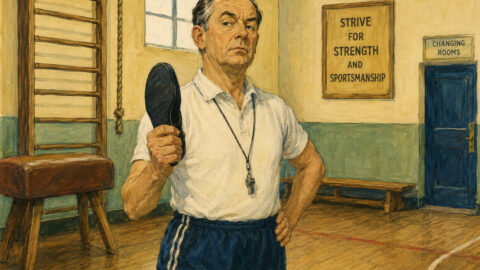
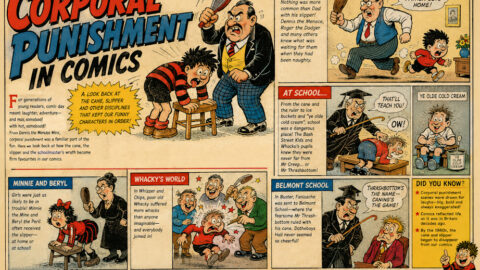
Perhaps that is why the subject remains so fascinating to those who experienced it.
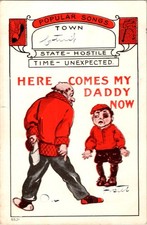
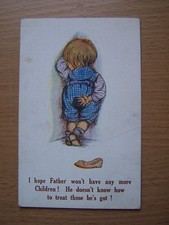
The boy who stood outside the Headmaster’s study was thinking principally of what was about to happen. The adult looking back upon the scene sees something rather different: the customs of a vanished school system, the curious standards by which boys judged one another, and the extraordinary importance which a few strokes of the cane—or fifty minutes in a classroom—could assume in the life of a schoolboy.
In the high schools of the period, discipline was a much more visible part of everyday life than it is today.
Masters and prefects exercised authority in ways which would now seem remarkably formal. A boy knew that an offence could result in a punishment which was both immediate and, in certain circumstances, humiliating.
Yet the system had its own unwritten rules.
A boy might dread the cane but boast about having received it. Another might privately prefer a more severe physical punishment to the embarrassment of having his parents informed about a detention.
Reputations were formed in corridors, classrooms and playgrounds, and a boy’s attitude towards punishment could become part of his standing among his fellows.
There were boys who seemed almost to cultivate the reputation of being regular recipients of the cane. At first they might be admired for their apparent courage. Eventually, however, the admiration could disappear.
Others dreaded the punishment in anticipation but found that, once it was over, the experience was less terrible than they had imagined.
And there were those, like myself, who would have chosen detention whenever circumstances permitted.
Looking back, I can see that my preference had little to do with the severity of the two punishments in any objective sense.
Detention was certainly inconvenient. It took fifty minutes from the end of the school day and resulted in an entry upon one’s record. It could also lead to awkward questions at home.
But the cane involved something altogether different.
There was the fear beforehand, the formal journey to the place of punishment, the enforced position, the presence of witnesses in some circumstances, and the knowledge that the experience would remain vividly in one’s memory.
There was also the curious fact that a boy could never be entirely certain how he would behave when the moment arrived.
Would he remain silent? Would he flinch? Would his schoolfellows admire him afterwards, or laugh at him?
Such questions were of enormous importance to a schoolboy.
The passage of time changes one’s view of these matters. What seemed at the time to be an all-important question of personal honour can, decades later, appear as one small detail in the much larger story of growing up.
Nevertheless, the memories remain remarkably clear.
The tower, the prefects’ room, the Headmaster’s study, the long afternoon detention, the prescribed essay and the possibility of one’s parents being informed—all belong to a school system which has now largely disappeared.
If someone had actually offered me the choice in those days, however, I doubt that age or reflection would have altered my answer.
I should have chosen detention.
And I suspect that, given the opportunity, I should still have made the same choice.