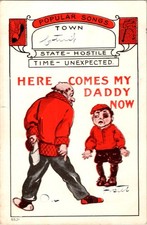
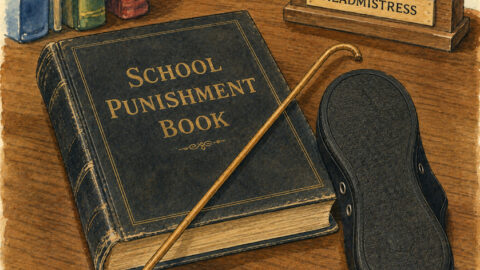
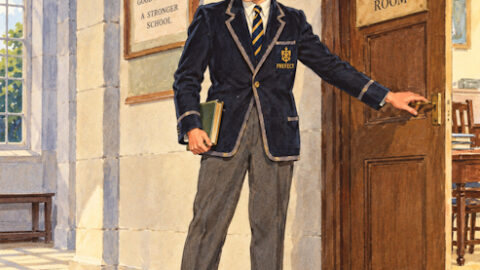
If there was one episode that seemed to capture the changing mood of the mid-1960s, it was not the abolition of corporal punishment, for that still lay some years ahead in many schools. Nor was it a dramatic confrontation between rebellious pupils and authoritarian masters. Rather, it was a curious sense of embarrassment. Corporal punishment continued to exist, yet those charged with administering it increasingly behaved as though they realised that its place in modern education was becoming difficult to defend.
One former pupil recalled an incident from 1965 which remained vivid decades later, not because the punishment itself was especially unusual, but because of the awkwardness that surrounded it.
By then he was a member of the Sixth Form at a Catholic grammar school, part of the senior elite whose privileges were understood as much through unwritten custom as through official regulations. Sixth Form boys enjoyed a degree of freedom unknown to younger pupils. They mixed more easily with the staff, accepted greater responsibility, and occupied a curious position somewhere between schoolboy and adult.
Among those unwritten customs was a code understood by virtually everyone in the school.
Prefects did not report Sixth Formers.
Officially, no such rule existed. The school handbook said nothing about it, and no announcement had ever been made. Yet it was one of those conventions that governed school life every bit as effectively as written regulations. Should a prefect encounter a senior boy committing some relatively minor offence, the accepted practice was to turn a blind eye, offer a quiet warning or allow the matter to be resolved informally.
Even members of the teaching staff appeared to recognise the convention.
The arrangement reflected more than simple favouritism. It acknowledged the Sixth Form’s semi-adult status. Younger boys were supervised. Seniors were expected to regulate themselves.
Then one afternoon the convention collapsed.
The offence itself was commonplace enough.
Smoking.
Like many schools of the period, the grammar school prohibited smoking by pupils, despite the fact that many boys approaching adulthood smoked openly outside school hours. A prefect happened upon the offender and, whether through enthusiasm, inexperience or excessive conscientiousness, submitted an official report.
Immediately he realised his mistake.
The report could not simply disappear. Once lodged, it demanded action. The school authorities had little choice but to proceed.
Interestingly, it was the reporting prefect rather than the offender who soon found himself under quiet criticism. Some time afterwards he approached the older boy in an awkward attempt at reconciliation, offering something very close to an apology. It was widely assumed that the First Prefect, himself a priest, had privately explained that certain traditions existed for good reason and that he had overstepped accepted practice.
The damage, however, had already been done.
School discipline, once formally invoked, possessed a momentum of its own.
The authorities were now obliged to impose punishment.
Yet what happened next revealed just how much attitudes had altered.
Instead of treating the caning as routine, the priest responsible for carrying it out arranged a private meeting with the Sixth Former. Rather than requiring him to attend at the usual punishment period, when younger boys would inevitably notice him entering or leaving the punishment room, an alternative time was quietly agreed.
It was, in effect, a discreet accommodation.
No public humiliation.
No curious juniors watching from the corridor.
No whispered speculation as another senior disappeared behind the study door.
The boy later admitted that he felt almost absurdly grateful for this small kindness. Looking back, he recognised that the punishment itself mattered less than the effort made to preserve his dignity.
Such an arrangement would scarcely have attracted comment ten years earlier.
During the 1950s many schools regarded public knowledge of punishment as an important element of discipline. A boy seen reporting to the headmaster’s study served as a warning to others. The possibility of humiliation often reinforced the authority of the punishment itself.
By the mid-1960s, however, some schools appeared increasingly reluctant to expose older pupils to that form of public embarrassment.
This reluctance reflected broader changes in educational thinking.
Teachers still believed in maintaining discipline, yet many had begun distinguishing between correction and humiliation. A private interview increasingly seemed preferable to a public spectacle. Even where corporal punishment survived, efforts were often made to conduct it with greater discretion than had been customary a decade before.
The headmaster’s study remained a place surrounded by mystery.
For younger boys it possessed an almost mythical quality. They imagined the interview, the lecture, the solemn pronouncement of sentence and the inevitable production of the cane from its cupboard or drawer. Those who had experienced the process rarely discussed details openly. A curious code of reserve surrounded such occasions.
Older boys, in particular, often spoke less about the punishment than about the interview preceding it.
Many remembered the conversation.
Questions about the offence.
Disappointment rather than anger.
Warnings about future conduct.
Occasionally even expressions of reluctant sympathy.
The punishment itself occupied only a few moments. The interview could linger much longer in the memory.
One former pupil observed years later that the cane increasingly seemed almost symbolic. Its authority rested not simply in the physical punishment but in everything surrounding its administration—the summons, the waiting, the silence of the corridor, the knowledge that one had been singled out by the highest authority in the school.
As the decade progressed, these rituals themselves began to feel strangely old-fashioned.
The younger teachers entering grammar schools had often completed university only recently. They belonged to a generation less instinctively attached to Edwardian traditions. Some had undertaken teacher training that emphasised psychology, motivation and communication rather than unquestioning obedience.
Their senior colleagues sometimes regarded such ideas with scepticism.
“Spare the rod and spoil the child” remained a familiar proverb in many staff rooms. Numerous experienced teachers genuinely believed that occasional corporal punishment prevented more serious problems developing. Better, they argued, to deal firmly with misconduct immediately than allow indiscipline to spread throughout the school.
Yet even among supporters of corporal punishment subtle differences were emerging.
There were masters who used the slipper almost automatically, reaching for it with scarcely a second thought whenever classroom order deteriorated.
Others regarded it as an exceptional measure.
Some retained the cane in a cupboard for years without ever using it.
Everything depended upon personality.
Pupils recognised these differences with remarkable accuracy. Every school possessed masters known for severity and others admired for never needing to resort to physical punishment at all. Curiously, many of the latter commanded no less respect than their stricter colleagues. Indeed, some commanded considerably more.
This observation would later become significant in debates about educational discipline.
If excellent order could be maintained without routine corporal punishment, was the cane truly indispensable?
Such questions gained increasing prominence during the latter half of the 1960s.
Many boys leaving grammar school around this time assumed they had witnessed the closing chapter of a long educational tradition. Corporal punishment still existed, certainly, but it seemed to be retreating. Teachers appeared less eager to employ it. Senior pupils regarded it as faintly anachronistic. Public opinion seemed steadily moving in another direction.
Several former pupils have recalled entering adult life convinced that the cane’s days were numbered.
The surprise would come later.
Much later.
During the 1970s they discovered that while some schools had quietly abandoned corporal punishment altogether, others continued to administer slipperings and canings with remarkable regularity. The apparent decline they believed they had witnessed proved far from universal.
It was a discovery that challenged many assumptions.
Perhaps they had mistaken local change for national change.
Perhaps their own schools had been unusually progressive.
Or perhaps British education, like British society itself, had entered a period in which old certainties refused to disappear as quickly as many had expected.
Whatever the explanation, the optimism that had characterised the middle years of the decade would soon encounter a far more complicated reality.