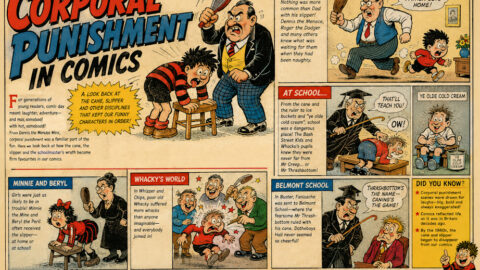
The discussion inevitably moved from birthday customs towards the much larger subject of school corporal punishment.
For much of the twentieth century, physical punishment formed an ordinary part of school life on both sides of the Atlantic.
The instruments differed.
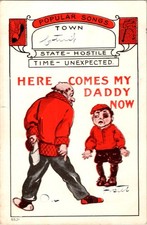
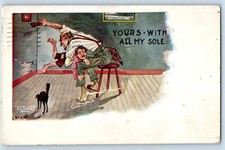
British schools became associated with the cane, slipper and, particularly in Scotland, the leather strap or tawse.
American schools became especially associated with the wooden paddle.
What is striking, however, is how differently this history has subsequently been represented in popular culture.
British films and television dramas have rarely concealed the existence of corporal punishment in earlier schools.
Productions depicting school life have frequently included it where historically appropriate.
Some contributors to the debate argued that American cinema and television have been rather more reluctant to portray the paddle, despite its widespread historical use.
This is an interesting observation, although one which would require considerably more systematic research before firm conclusions could be drawn.
Nevertheless, it raises an important question about collective memory.
Societies do not remember their past simply through history books.
They remember it through films, novels, television programmes, photographs and personal recollections.
What popular entertainment omits can sometimes be almost as influential as what it includes.
A youngster watching a drama set in an American school of the 1950s or 1960s might therefore receive a rather different impression of school discipline from somebody watching a British drama covering the same period.
Yet corporal punishment was hardly an obscure practice in American education.
This historical background makes the birthday controversy still more complicated.
An object or action cannot always be separated from its previous meaning merely by declaring it a joke.
Where generations of pupils associated a paddle with punishment, its use in a supposedly playful ceremony carries unavoidable historical baggage.
The same would surely have been true had a British headmaster taken a cane traditionally kept for discipline and suddenly introduced it into birthday celebrations.
Pupils would hardly have regarded the object as symbolically neutral.
There is also a danger that turning instruments of discipline into toys trivialises both their history and the feelings of those who experienced them.
Whatever one’s opinion of historical corporal punishment, it was intended to be a serious disciplinary measure.
It was not originally conceived as entertainment.
This does not mean that every reference to old school discipline must be treated solemnly.
People frequently look back upon childhood experiences with humour.
But institutions themselves carry a different responsibility.
Schools must distinguish between history, discipline and entertainment.
When those boundaries become blurred, confusion inevitably follows.
And confusion is a particularly poor foundation upon which to build either discipline or trust.