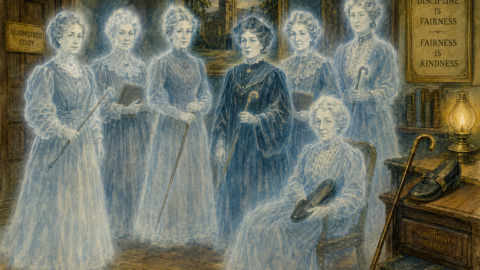
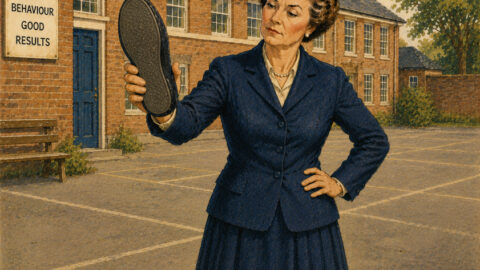
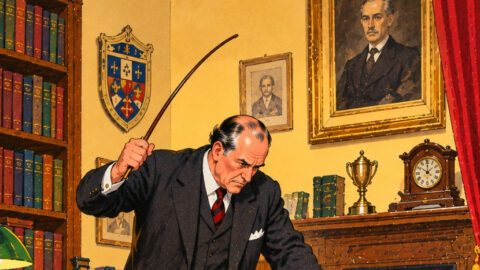
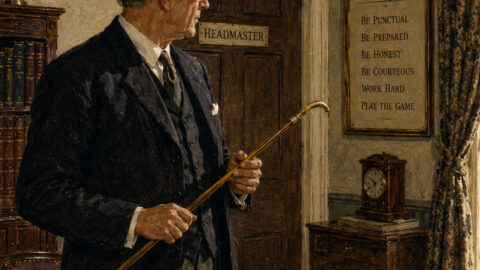
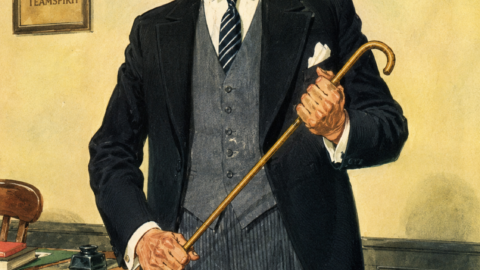
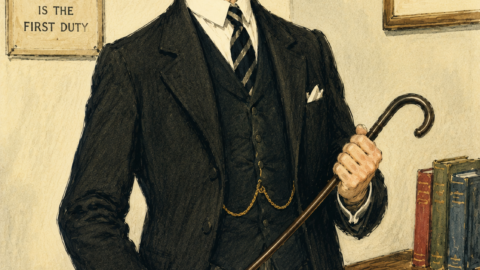
The headmaster naturally dominates popular memories of traditional school discipline.
Yet the survey demonstrates that considerable authority could also be exercised by other senior members of staff.
The deputy head, senior mistress, housemaster and heads of departments all appear as disciplinary figures.
The Deputy Head
The deputy head frequently acted when the headmaster was unavailable or when an offence was serious enough to require senior attention without necessarily requiring the head himself.
One grammar-school boy caught running in a corridor in 1964 was taken to the deputy head’s office.
He received three strokes and later stated that he never repeated the offence.
The incident illustrates how rapidly a minor breach could become a formal disciplinary matter when witnessed by a senior member of staff.
The Senior Mistress
The senior mistress could occupy an equally important position.
One contributor recalled encountering the senior mistress while he was outside his classroom after repeated talking.
She took him to her office and administered the punishment herself.
A year later, the same senior mistress dealt with his repeated failure to complete homework.
These recollections demonstrate that disciplinary authority was not confined to male staff.
Heads of Department
A head of department might also possess considerable authority.
The mathematics pupil caught truanting in 1969–70 was dealt with by the head of mathematics rather than the headmaster.
This arrangement allowed serious subject-related misconduct to be handled within the department.
The Housemaster
In boarding schools, and in schools organised into houses, the housemaster occupied a special position.
His authority could extend beyond lessons into the wider life of the pupil.
Dormitory behaviour, evening conduct and breaches of house rules could all fall within his responsibility.
One boarding-school contributor recalled repeated punishment for dormitory offences, including talking after lights-out.
A Hierarchy of Authority
These examples suggest that school discipline frequently operated through a hierarchy.
The classroom teacher dealt with ordinary behaviour.
The head of department or senior teacher handled more persistent problems.
The deputy head or senior mistress dealt with serious or repeated misconduct.
The headmaster remained the final authority.
This hierarchy was not identical everywhere.
Some classroom teachers could use the cane.
In other schools they could not.
Some heads reserved formal punishment entirely to themselves.
Nevertheless, the general principle of escalating authority appears repeatedly.
More Than the Headmaster
The traditional image of corporal punishment as something administered exclusively in the headmaster’s study is therefore incomplete.
Many pupils could pass through several levels of discipline without ever appearing before the head.
To understand the system properly, we must look beyond the headmaster and examine the entire structure of authority beneath him.
The cane might symbolise the headmaster’s authority.
In practice, however, school discipline was often a shared responsibility.