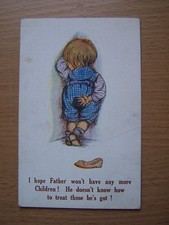
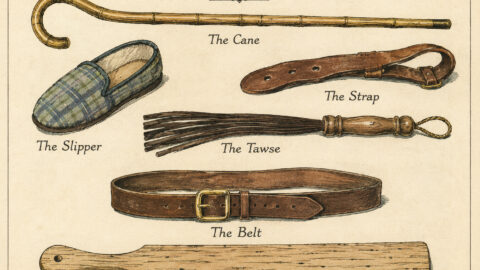
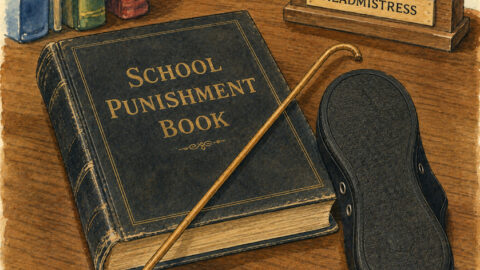
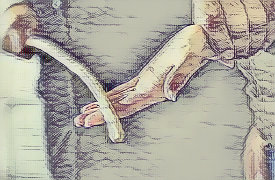
Compared with the cane that rested in Miss Beatrice Blyton’s study, the slipper was considered a far more ordinary instrument of school discipline. It lacked the ceremony of a visit to the Headmistress’s office and carried none of the fearful reputation that surrounded the thin rattan cane. Even so, generations of pupils knew that a rubber-soled slipper could command every bit as much respect.
Not every member of staff believed in its use.
Several teachers quietly preferred patience over punishment, believing that kindness, encouragement and perseverance would win over even the most troublesome child. Others accepted corporal punishment only as a final measure, something to be employed when every warning, detention and stern conversation had failed.
Mrs Bellamy belonged firmly to another school of thought.
To her, discipline was the foundation upon which education rested. Without order there could be no concentration. Without concentration there could be no learning.
“The children are here to be educated,” she would often remark. “Not to run wild.”
Her slipper was utterly unremarkable.
It was an elderly blue ladies’ house slipper with a thick black rubber sole, showing the signs of many years of faithful service. During lessons it rested quietly inside the top drawer of her desk beside the attendance register, a box of chalk, several red marking pencils and a neatly folded handkerchief.
The drawer was never locked.
It did not need to be.
Every child in the classroom knew precisely what rested inside.
Merely hearing the drawer slide open could bring an instant hush across the room.
Curiously, Mrs Bellamy rarely raised her voice.
She possessed the remarkable ability to restore silence simply by removing her spectacles, placing them carefully upon the desk and looking slowly around the classroom.
That expression alone was often enough.
The slipper itself was used surprisingly infrequently.
Its reputation accomplished far more than its actual application.
When punishment did become necessary, it followed a familiar routine which varied little from year to year.
A pupil who had deliberately disrupted a lesson, shown repeated defiance, bullied another child or displayed open insolence would be instructed to remain in the classroom after the final bell.
The rest of the class would file quietly out.
There were never cheers, whispers or lingering glances.
Everyone knew better.
In many cases another member of staff—or occasionally a senior prefect—would remain as a witness. Such precautions were considered sensible practice, protecting both teacher and pupil from any later misunderstanding.
Mrs Bellamy believed firmly that punishment should never be delivered in anger.
She would first explain exactly why the pupil had remained behind.
“You have ignored three warnings.”
“You deliberately interrupted the lesson.”
“You answered a teacher with rudeness.”
Each offence was stated calmly and clearly.
Only then would she explain the consequence.
The punishment was administered quickly, with as little ceremony as possible, before she invited the pupil to compose themselves, straighten their clothing and return home.
Finally, the details were entered carefully into her small black notebook.
Date.
Name.
Offence.
Punishment administered.
It was all recorded with neat, immaculate handwriting.
Looking back from the twenty-first century, many would undoubtedly find such scenes deeply uncomfortable. Modern educational practice had moved in an entirely different direction, placing greater emphasis upon emotional wellbeing, restorative approaches and positive reinforcement.
Yet during the 1950s the matter was viewed very differently.
For countless parents, reasonable corporal punishment was simply another accepted feature of school life.
Indeed, some believed schools had become far too lenient.
Miss Beatrice Blyton’s office received a steady trickle of letters expressing precisely that opinion.
One father wrote:
“My daughter knows perfectly well what is expected of her. If she breaks the rules, she must also accept the consequences. Discipline at home means little if discipline at school is ignored.”
Another parent thanked the staff for maintaining standards which, in his opinion, prepared children for adult life.
“They will meet stricter people than teachers once they leave school.”
Not every letter, however, offered praise.
Occasionally an envelope would arrive expressing genuine concern.
One thoughtful mother explained that her son had become increasingly anxious during mathematics lessons.
Although he had never received the slipper himself, he had witnessed another boy being punished.
Since then, she wrote, he became visibly nervous whenever Mrs Bellamy walked slowly between the desks.
His arithmetic deteriorated.
Simple sums became muddled.
The fear of making a mistake seemed to overwhelm his ability to think.
Miss Beatrice Blyton always answered such correspondence personally.
Her replies were courteous, measured and respectful.
She acknowledged every parent’s concern and assured them that no child would ever receive corporal punishment simply because they struggled with schoolwork.
“Inability,” she wrote, “is never an offence.”
Children learned at different speeds.
Some required additional explanation.
Others needed patience.
Those were educational challenges, not disciplinary ones.
“But deliberate carelessness,” she continued, “persistent idleness after repeated encouragement, or open insolence towards members of staff are entirely different matters.”
Within the staffroom itself, opinions remained far from unanimous.
Miss Pritchard, who had taught for nearly thirty years, believed the slipper ended persistent disruption quickly and allowed lessons to continue peacefully for everyone else.
“In five minutes,” she would say, “one troublesome child can spoil an hour’s education for thirty others.”
Mrs Palmer disagreed.
She preferred detention, extra written work or requiring pupils to apologise publicly for poor behaviour.
“Children remember embarrassment longer than pain,” she once remarked quietly.
Then there was Miss Alice Fenwick, the youngest mistress on the staff.
Fresh from teacher training college, energetic and full of new educational theories, she regarded physical punishment as entirely unnecessary.
She believed children learned best through encouragement, curiosity and trust.
One rainy afternoon, as the teachers gathered around the staffroom fire with cups of tea balanced carefully upon their knees, the discussion surfaced once again.
“I simply cannot believe,” Miss Fenwick said thoughtfully, “that fear produces genuine learning.”
Several teachers looked up.
“It produces silence,” replied Miss Pritchard.
“Silence isn’t education,” Miss Fenwick answered.
She paused before adding gently,
“A frightened child may obey every instruction. But obedience is not the same thing as understanding.”
For a moment nobody spoke.
Only the ticking of the wall clock and the gentle clink of teaspoons disturbed the silence.
Mrs Bellamy, who had been stirring her tea with great concentration, finally looked up.
She smiled very slightly.
“It is,” she replied in her calm, matter-of-fact voice, “a very useful beginning.”
No one argued further.
Outside, the afternoon bell rang across the playground.
Within moments the corridors once again filled with the familiar sound of polished shoes, children’s voices and the steady rhythm of another ordinary school day at St Bartholomew’s under the watchful eye of Miss Beatrice Blyton.