One of the difficulties in describing British school corporal punishment is that there was never one universal experience.
Ask ten former pupils what happened at their schools and you may receive ten completely different answers.
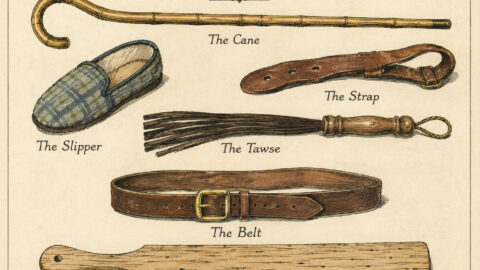
At one school the cane might have been reserved for the headmaster. Somewhere else, senior teachers could use it. At another school the cane was rarely seen, but the slipper appeared regularly. Elsewhere, the ruler was the preferred method of dealing with minor misbehaviour.
Geography played a part as well.
Scotland became particularly associated with the leather tawse, while the cane and slipper became familiar features of many English schools. Other countries developed their own traditions: the strap became associated with parts of Canada, while the wooden paddle became particularly familiar in the United States.
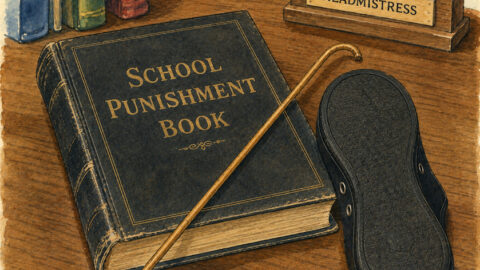
Even the famous British “slipper” could cause confusion.
It was generally not a bedroom slipper at all. It was normally a rubber-soled plimsoll or gym shoe. One explanation suggested in the original recollections is that boarders at some preparatory schools wore elasticated plimsolls as “house slippers”, which may have contributed to the terminology.
Whatever its origins, generations of pupils understood exactly what “the slipper” meant.
The greatest difference, however, was often not the implement.
It was the teacher holding it.
Some teachers used corporal punishment reluctantly. Others seemed to regard it as an essential part of maintaining classroom discipline. Consequently, two children attending different schools—or even sitting in different classrooms within the same school—could experience completely different standards.
One teacher might overlook talking in class.
Another might reach immediately for the ruler.
One headteacher might reserve the cane for fighting, bullying or serious defiance. Another might consider repeated lateness or disobedience sufficient.
Gender created further differences.
Boys were often more likely to receive corporal punishment, particularly as pupils grew older, but girls were by no means universally spared. The original recollections include memories of both boys and girls receiving physical punishment and of teachers using the ruler, slipper or other methods on pupils of either sex.
The treatment of younger children also varied.
Some schools were reluctant to cane junior pupils, preferring the slipper or ruler instead. Other establishments apparently had fewer such reservations. What was considered reasonable depended enormously upon the period, school and individual teacher.
This inconsistency eventually became one of the strongest arguments against the system.
If corporal punishment was genuinely an essential educational tool, why did its use differ so dramatically?
Why could one pupil receive a warning for something that earned another pupil the slipper?
Why could behaviour that resulted in detention at one school lead to the cane at another?
And perhaps most importantly, who decided when enough was enough?
For generations the answer had largely been straightforward:
The teacher decided.
That answer became increasingly difficult to defend as attitudes towards children, education and personal rights began to change.
The old classroom had been built around unquestioned authority.
But society itself was changing.
Children were beginning to be viewed less as young people who simply had to obey and increasingly as individuals whose treatment required limits and safeguards.
The cane, slipper, ruler and tawse had survived because generations had accepted the authority behind them.
Once that authority began to be questioned, the future of corporal punishment became much less certain.