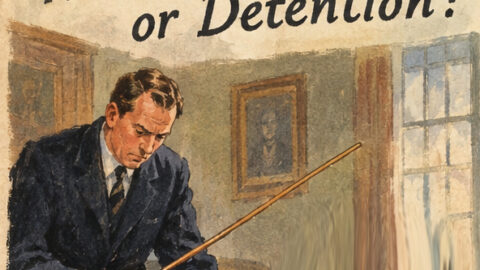
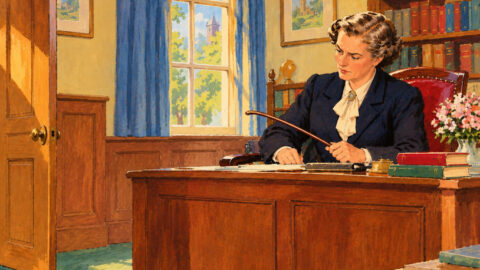
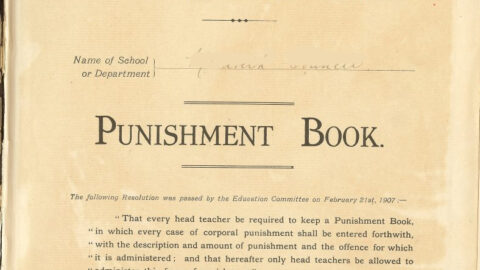
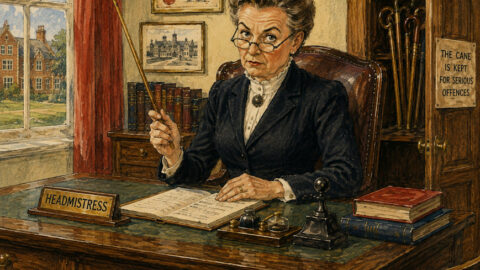
Although the popular image of school corporal punishment is usually that of a pupil bending over for the cane or slipper, punishment on the hand was also widespread.
In some schools it was the normal method. The cane, strap, ruler or tawse might all be applied to the hand, depending upon the traditions of the school and the part of Britain concerned.
One contributor recalled that at his primary school younger children received the wooden ruler on the backs of the legs, while older pupils could receive the cane on the hands. At secondary school the strap was used on the hands.
Another account, from Oldfields Boys School in Uttoxeter in 1972, concerns a thirteen-year-old boy punished after taking a packet of crisps from a faulty vending machine.
The headmaster administered six strokes with the strap—three to each hand.
The boy stood while holding out his hand and was punished in the presence of two other pupils involved in the same incident.
He remembered queues of boys waiting outside the headmaster’s office and regarded corporal punishment as a familiar feature of the school’s disciplinary arrangements.
He did not repeat the offence and considered the punishment effective.
The Extended Hand
Punishment on the hand required little preparation.
The pupil stood before the teacher and extended one hand, usually palm upwards. After receiving the required number of strokes, the other hand might be presented.
This made the punishment particularly convenient for classroom use.
No desk or chair was required and there was no need for the pupil to adopt the bending position associated with caning on the seat.
Yet convenience did not necessarily mean mildness.
Several contributors regarded punishment on the hand as particularly unpleasant.
The hand contains numerous sensitive structures, and a forceful stroke could produce considerable immediate discomfort. The pupil might subsequently have difficulty writing or performing other tasks.
The Strap
The strap was particularly associated with punishment of the hands.
However, the word “strap” covered a considerable variety of instruments.
Some were comparatively light. Others were thick and heavy. Different materials produced noticeably different effects.
One contributor who experienced several forms of strapping remembered that a particular strap made an impressive noise but did not produce quite the same sensation as the heavier rubber straps used by other teachers.
His recollection is useful because it demonstrates once again that the name of an implement tells us surprisingly little about the actual severity of a punishment.
Two teachers could both record “two strokes of the strap” while administering punishments which felt quite different to the recipients.
Boys and Girls
Punishment on the hand was also sometimes used where schools distinguished between the treatment of boys and girls.
One account from 1969 concerns a boy punished for smoking. He received six strokes of the cane, while two girls involved in the same incident were given three strokes on the hand.
Whether such arrangements constituted greater leniency towards the girls is difficult to determine.
A smaller number of strokes does not automatically indicate a milder punishment if a different part of the body is involved.
This difficulty appears repeatedly throughout the survey.
Attempts to compare punishments mathematically—three strokes against six, hand against seat, strap against cane—can give a false impression of precision.
Practical Considerations
Punishment on the hand also differed from other forms of corporal punishment because its effects could interfere directly with schoolwork.
A sore hand still had to hold a pen.
For this reason some schools appear to have limited the number of strokes or alternated between the hands.
Yet practices differed so widely that generalisation is dangerous.
The important conclusion is that punishment on the hand was not an insignificant variation upon the better-known school caning.
For many pupils it was school corporal punishment.
Their principal fear was not being ordered to bend over a desk, but hearing the instruction:
“Hold out your hand.”