For many people, the traditional image of girls’ schools evokes thoughts of strict uniforms, impeccable manners, and the old saying that girls were made of “sugar and spice and all things nice.” However, surviving school punishment books paint a far more complex picture. These official records reveal that girls, like boys, were disciplined for a surprisingly wide range of offences, from relatively minor acts of disobedience to serious challenges to school authority.
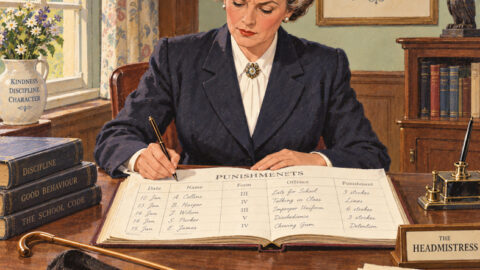
The offences recorded in these punishment books included leaving school without permission, general disobedience, rudeness, truancy, forging letters from parents, throwing stones, defacing school property, hiding another pupil’s belongings, impatience, and even the remarkable offence of striking the headmistress.
Viewed through modern eyes, the punishments often appear surprisingly restrained considering the attitudes towards discipline that prevailed throughout much of the twentieth century. Many former pupils who experienced corporal punishment have remarked that several of these offences would almost certainly have attracted much harsher penalties in their own schools.
Of course, it is difficult to judge individual cases solely from the brief entries found in punishment books. A single word such as “impatience” tells us very little about what actually occurred. Was it a simple refusal to follow instructions, persistent insolence, or behaviour that disrupted an entire lesson? Likewise, an entry recording “general disobedience” could encompass anything from refusing to complete work to openly defying a teacher.
Some offences, however, clearly stood apart. “Striking the headmistress” was an exceptionally serious act in an era when respect for authority was expected without question. In many schools, such behaviour could have resulted not only in a severe corporal punishment but potentially suspension or expulsion.
The offence of forging a letter from parents also featured regularly in punishment books. This was often regarded as more serious than the original wrongdoing it attempted to conceal. A pupil who forged a note to excuse an absence might well receive a heavier punishment for the deception than for the truancy itself. Former pupils have recalled cases where forged parental letters resulted in six strokes of the cane, while the unauthorised absence would likely have attracted a considerably lighter punishment had it simply been admitted.
The Historical Value of Punishment Books
Original punishment books remain among the most important surviving records documenting the administration of corporal punishment in British schools. For researchers, historians and former pupils alike, they provide a rare glimpse into how discipline was officially recorded and administered.
Many former pupils have expressed an understandable interest in seeing the entries that relate to their own punishments. This presents a difficult dilemma. While an individual may wish to view their own record, the pages inevitably contain the names and details of numerous other pupils, raising understandable privacy concerns. Even where a person remembers the circumstances of their own punishment and those punished alongside them, access to the complete record is not always straightforward.
Some former members of staff who witnessed punishments during their careers may still have some knowledge of where these books were stored or what ultimately became of them after schools closed or merged. Unfortunately, many punishment books have since disappeared, while others remain in archives or private collections.
Errors and Omissions in Official Records
Although punishment books are valuable historical documents, they should not automatically be regarded as complete or perfectly accurate records.
There are documented cases where corporal punishments were administered but never entered into the official punishment book. Whether through oversight, administrative convenience or deliberate omission, these missing entries suggest that surviving records almost certainly understate the true number of punishments administered.
If such omissions occurred regularly across hundreds or even thousands of schools over several decades, the cumulative effect could amount to many hundreds, perhaps even thousands, of corporal punishments that were never officially recorded.
Researchers therefore need to treat punishment books as important primary sources while recognising that they represent only the documented portion of a much larger historical picture.
School Inspectors and Their Role
Many punishment books contain the initials or signatures of managers, clerks or school inspectors, indicating that the records were periodically examined as part of official inspections.
Exactly how detailed these inspections were remains open to debate. In some cases, inspectors may simply have confirmed that punishments were being properly recorded in accordance with educational regulations before initialling the register. In others, they may have examined the entries more closely and commented on patterns of discipline within the school.
Interesting questions remain unanswered. If an unusual punishment had been recorded—or, equally, if essential details had been omitted—would an inspector have queried the entry?
One example concerns a pupil named Clara Teale, whose punishment record noted that she refused to hold out her hand and instead had to bend over to receive her punishment. Curiously, the number of strokes administered was omitted from the official entry. Whether this omission was ever questioned during inspection remains unknown.
Another intriguing question concerns the implements themselves. Did inspectors examine the school canes or straps to ensure they complied with Local Education Authority regulations, or was their attention focused solely on the written records? Documentary evidence on this aspect of inspections remains limited.
Discoveries of Original Punishment Books
Original punishment books occasionally emerge in private collections or at auction, offering historians fresh opportunities to study school discipline.
One notable example surfaced in recent years when a punishment book from a Technical School for Boys, covering the years 1945 to 1960, appeared for sale. The volume attracted considerable interest from collectors before eventually selling for £143.
What made this particular register especially unusual was that it recorded three different implements of corporal punishment. Alongside the number of strokes administered, the entries specified whether punishment had been carried out using a cane, a leather strap or rubber tubing.
The inclusion of rubber tubing is particularly striking. Unlike the cane and leather strap, rubber tubing is not generally regarded as an officially authorised instrument in British schools, making its appearance in an official punishment register rather unexpected.
One page also carried the stamp of the Local Education Authority. Although initially difficult to identify, the stamp was later recognised as belonging to Barrow-in-Furness.
At the time, Barrow formed part of the detached northern section of Lancashire, separated geographically from the rest of the county by Westmorland. Lancashire had a long-established preference for the leather strap rather than the cane, a tradition that extended to many schools educating both boys and girls.
Former pupils educated in Lancashire during the 1960s and 1970s have frequently recalled that the strap remained the standard instrument of corporal punishment long after many other parts of England had adopted the cane almost exclusively.
England and Scotland: Different Record-Keeping Traditions
While most schools in England were required to maintain formal punishment books recording corporal punishment, no comparable universal requirement existed in Scotland.
As a result, Scottish researchers often rely more heavily on school log books, education authority records and personal recollections when reconstructing disciplinary practices.
Ironically, despite England’s more systematic record-keeping, the surviving punishment books should not be regarded as complete statistical records. Evidence that some punishments were never entered suggests that even where official documentation existed, it failed to capture every instance of corporal punishment administered.
Consequently, punishment books remain invaluable historical documents, but they should be viewed as one important source among many. Combined with inspection reports, school log books, archival records and the recollections of former pupils and teachers, they help build a richer and more accurate picture of how discipline operated in British schools during the era when corporal punishment formed an accepted part of education.