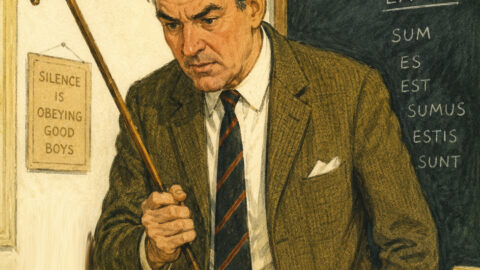
Just as pupils acquired reputations, so did teachers.
Within weeks of entering a new school, children generally knew which members of staff were strict and which were comparatively easy-going.
This knowledge rarely came from official school information.
It came from other pupils.
The Feared Teacher
Some teachers became legendary.
Their arrival in a noisy classroom could produce immediate silence.
Whether they actually punished more frequently than their colleagues is sometimes impossible to establish.
Reputation alone could do much of the work.
One contributor recalled encountering a housemaster with a fearsome reputation after being caught running in a corridor.
The pupil knew at once that punishment was likely and remembered being extremely frightened.
In the event, the punishment was less severe than expected.
This illustrates an important disciplinary principle.
A teacher’s reputation could be more powerful than the punishment actually administered.
Physical Education Teachers
Physical education masters appear repeatedly in the recollections.
The reasons are not difficult to understand.
Gymnasiums and playing fields provided numerous opportunities for horseplay, disobedience and breaches of safety rules.
The slipper was also readily available in the form of a gym shoe.
Several contributors remembered physical education teachers as particularly formidable disciplinarians.
Yet these are recollections rather than reliable statistics.
The survey cannot establish that physical education teachers as a group punished more severely than teachers of other subjects.
It can only show that a number of respondents remembered them that way.
Teachers Who Rarely Punished
The opposite could also be significant.
A teacher known rarely to use corporal punishment might make a considerable impression on the occasion when he did.
One boy caned in 1959 for poor work specifically remembered his surprise because his teachers did not normally use the cane.
He subsequently took greater care with his work for the remainder of the year.
The rarity of the punishment may therefore have increased its significance.
Frequent Use and Diminishing Effect
A teacher who punished constantly faced a different difficulty.
If the slipper appeared every lesson, pupils might begin to regard it as routine.
Fear could be replaced by familiarity.
This possibility appears indirectly in several recollections of boys who became regular recipients.
The punishment still hurt, but its psychological significance diminished.
A balance was therefore required if corporal punishment was intended primarily as a deterrent.
The threat had to be credible without becoming ordinary.
Did Teachers Enjoy Punishing?
Former pupils sometimes suspected that particular teachers enjoyed administering corporal punishment.
Such allegations require great caution.
A strict teacher, an enthusiastic disciplinarian and a teacher who actually derived pleasure from punishment are not necessarily the same thing.
The survey contains recollections and opinions, not evidence from the teachers themselves about their motives.
It would therefore be improper to state as fact that a teacher “enjoyed” punishment merely because pupils believed this to be so.
What can safely be said is that children formed strong opinions about the attitudes of their teachers.
A teacher who appeared eager to punish could lose respect even while maintaining obedience.
Authority based upon fairness was not the same thing as authority based upon fear.