Corporal punishment had a social life of its own.
It was discussed in playgrounds, changing rooms, corridors and classrooms.
Pupils knew who had been punished.
They knew which teachers were feared.
They exchanged information about the cane and slipper.
In some boys’ schools, being punished could even contribute to a pupil’s reputation.
The Fear of Crying
A recurring concern in the accounts is whether the pupil cried.
This might seem a minor matter to an adult examining school discipline, but to children it could be extremely important.
The fear was not necessarily of tears themselves.
It was the fear of being seen crying by classmates.
One contributor remembered taking pride in having accepted a punishment without crying or resisting.
Another admitted that hopes of appearing brave disappeared once punishment began and remembered later crying privately.
These recollections reveal the influence of peer expectations.
The “Hard” Boy
Certain pupils acquired reputations for toughness.
A boy who could receive punishment without visible reaction might gain status among some of his classmates.
This produced an odd contradiction.
Corporal punishment was intended to discourage misconduct.
Yet in certain peer groups, enduring it bravely could become evidence of courage.
The punished pupil might therefore lose standing with teachers while gaining standing with classmates.
This was not universal.
Many pupils simply wished to avoid punishment and felt no admiration for those who received it regularly.
Nevertheless, the possibility complicates any simple theory of deterrence.
Returning to the Classroom
The moment after punishment could be socially difficult.
A pupil returning from the head’s office might immediately become the subject of attention.
Classmates wanted to know:
“What did you get?”
“How many?”
“Did it hurt?”
The answers would rapidly circulate.
Sometimes no explanation was necessary.
The pupil’s expression or manner made the outcome obvious.
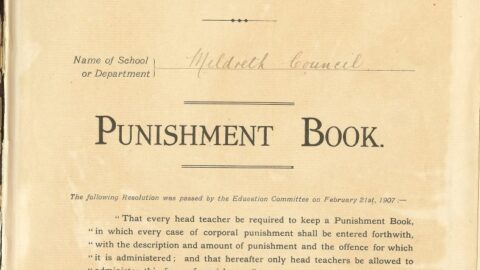
One grammar-school pupil recalled being caned for cheating and then having to carry the cane and punishment book back to the office. On arriving late for his next lesson, he was required to explain in front of the teacher why he had been delayed.
The punishment had therefore ended physically, but not socially.
The Well-Behaved Pupil
Embarrassment could be particularly acute for children with reputations for good behaviour.
One contributor described himself as one of the class “swots.” When unexpectedly punished, he considered the possibility of classmates discovering what had happened almost worse than the physical penalty.
This reminds us that the same punishment could possess different meanings for different pupils.
For the habitual offender it might be another familiar encounter.
For a child who had never previously been in serious trouble, it could threaten an established identity.
The Unofficial School Network
Children knew far more about their school’s disciplinary system than official regulations could ever reveal.
They knew which teacher possessed the largest slipper.
They knew who rarely punished.
They knew who had been sent to the headmaster that morning.
And they knew, with varying degrees of accuracy, what had happened behind the office door.
This unofficial network helped maintain the disciplinary system.
The reputation of punishment travelled far beyond the relatively small number of pupils actually receiving it.
In that sense, one punishment might influence an entire class.