Few places in England during the early 1970s seemed quite as separate from the outside world as Highdon School in the Sussex countryside.
Hidden behind tall red-brick walls and surrounded by ancient oak trees, the boys’ boarding school had changed very little since before the Second World War. Ivy climbed across its stone buildings. A weathercock turned slowly above the chapel tower, and every morning the school bell echoed across the playing fields long before the sun had fully risen.
To the people living in nearby villages, Highdon appeared peaceful and respectable.
Inside the gates, however, life ran by rules that had scarcely altered in decades.
The school believed firmly in discipline, smart appearance, good manners and hard work. Every minute of the day had its place. Every boy knew exactly where he was expected to be, and woe betide anyone who arrived late.
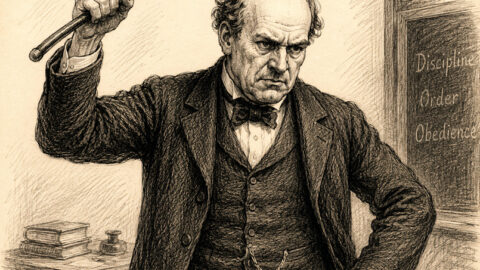
The Headmaster, Mr Edward Ashcombe, was a quiet man in his sixties whose calm voice was often more unsettling than shouting. He rarely raised it. He never needed to.
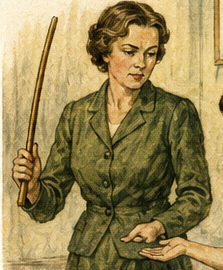
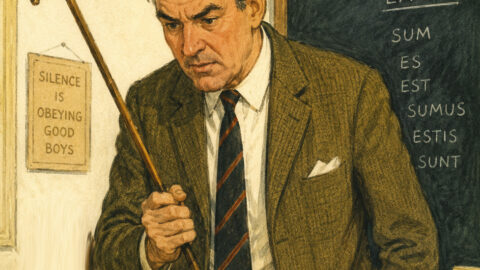
Resting inside the cupboard beside his desk were several well-polished school canes.
They were never displayed as decoration.
Their purpose was perfectly understood.
Although Mr Ashcombe administered the most serious punishments himself, much of the day-to-day running of Highdon rested in the hands of its predominantly female staff.
Some of them were remembered with enormous affection.
Others were remembered for rather different reasons.
Mrs Margaret Bellamy, the Senior Housemistress of Ash House, possessed a warm smile that often settled frightened newcomers. She knew when a homesick boy needed encouragement instead of criticism and quietly ensured that lonely first-years always found a letter from home before bedtime whenever one arrived.
She expected good behaviour.
But she also believed boys deserved kindness.
Miss Eleanor Harcourt held rather different views.
Tall, grey-haired and always immaculately dressed, she supervised the junior dormitories with military precision. Nothing escaped her notice. Beds had to be perfectly made. Shoes had to shine. Lockers had to be spotless.
Any untidiness earned a sharp rebuke.
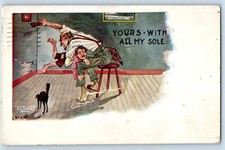
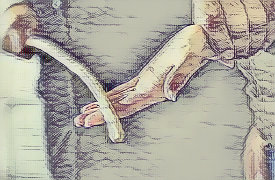
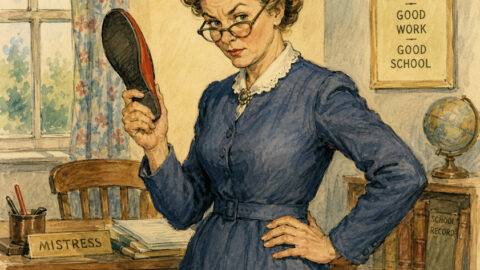
Repeated offences usually resulted in a visit to her office, where an old black gym slipper rested neatly inside the top drawer of her desk.
Every boy in the junior houses knew that drawer.
Few wished to see it opened.
Miss Beatrice Blyton taught English.
She adored books and could bring the adventures of Dickens, Stevenson and Conan Doyle vividly to life. During lessons she was patient, encouraging and endlessly enthusiastic.
Outside the classroom, however, she believed that good behaviour formed the foundation of good education.
“If boys learn self-control,” she often remarked, “they can learn almost anything.”
Mrs Dorothy Fenwick, who taught mathematics, was brisk but fair.
She disliked excuses more than poor sums.
“If you’ve made a mistake,” she would tell her class, “admit it honestly, correct it properly and move on.”
The boys respected her because they always knew where they stood.
Miss Prudence Gifford, the Matron, became something of a second mother to many of the younger boarders.
She dealt with scraped knees, headaches, homesickness and occasional tears with remarkable patience.
More than one boy secretly believed she was the nicest person in the whole school.
Then there was Miss Vera Pritchard.
She supervised evening preparation and was feared almost as much as Miss Harcourt.
Silence during prep was absolute.
The scratching of fountain pens across exercise books became the only sound.
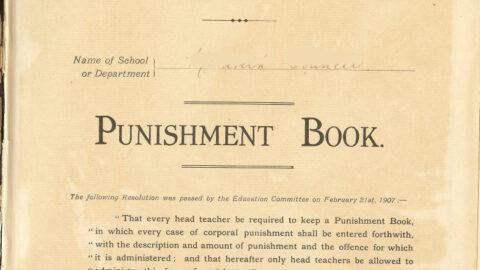
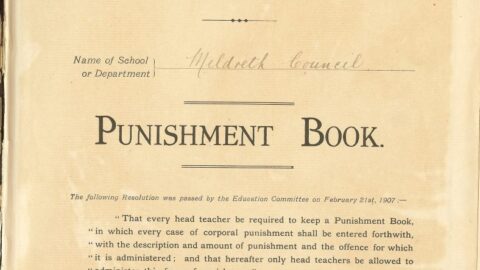
Anyone whispering risked having their name entered into the black leather punishment book that rested beside her chair.
The consequences depended entirely upon how often a boy’s name appeared.
Life at Highdon began every morning at precisely six-thirty.
The great brass bell echoed through the long corridors.
Within seconds doors opened, slippers slapped across polished wooden floors and prefects began marching from dormitory to dormitory.
“Up, everyone!”
“No hiding under the blankets!”
“Roll call in fifteen minutes!”
The younger boys scrambled from their beds.
Cold water from enamel jugs quickly removed any remaining sleep.
Uniforms were brushed.
Beds were tightened until blankets looked almost ironed.
Shoes stood perfectly beneath each bedframe.
Miss Harcourt carried out her inspections with remarkable attention to detail.
She ran a finger along window ledges searching for dust.
She checked wardrobes.
She examined folded pyjamas.
Sometimes she simply stood silently while nervous boys wondered what she had noticed.
If a bed failed inspection, the unfortunate owner remade it before breakfast.
If it failed again…
The famous slipper drawer occasionally opened.
Breakfast itself followed strict tradition.
The boys entered the great dining hall in complete silence.
Long wooden tables stretched beneath portraits of former headmasters whose stern faces seemed to watch every movement.
Only after grace could conversation begin.
Toast arrived in metal racks.
Large teapots steamed gently.
Bowls of porridge appeared first, followed by bacon, eggs and thick slices of bread spread generously with butter.
The meal lasted exactly twenty-five minutes.
Not twenty-four.
Not twenty-six.
Highdon believed punctuality built character.
Lessons began immediately afterwards.
The classrooms smelled of chalk, polished desks and leather-bound textbooks.
Most teachers expected complete concentration.
The boys stood whenever a member of staff entered.
Homework had to be neat.
Writing had to be legible.
Answers had to be honest.
The punishment system itself followed an equally clear pattern.
Minor offences usually earned extra work, detention or loss of privileges.
More persistent misbehaviour often resulted in a visit to the Housemistress.
Repeated defiance, dishonesty, bullying or serious breaches of school rules might eventually reach the Headmaster himself.
His study was perhaps the quietest room in Highdon.
It was also the room every boy hoped never to enter alone.
Yet Highdon was not simply a place of rules and punishments.
Friendships formed quickly.
Secret jokes spread around the dormitories after lights-out.
Midnight feasts occasionally appeared despite repeated searches.
Letters from home were treasured.
Victories on the rugby field were celebrated for weeks.
Even the strictest members of staff occasionally smiled when they believed nobody was watching.
For every difficult day there were adventures waiting around the next corner.
And for every stern teacher there was another whose encouragement could change a boy’s entire future.
No one arriving through Highdon’s great iron gates could possibly know which of those experiences awaited them.
But every new boy soon discovered one thing.
At Highdon School, discipline was never merely a word.
It was simply part of everyday life.