In July 1959, after more than three decades at the helm of St Anne’s School, Miss Beatrice Blyton made the announcement that few had ever imagined they would hear.
She was retiring.
For many of the pupils, particularly the younger girls who had only ever known St Anne’s under her firm but watchful guidance, it seemed impossible. Miss Blyton had become as much a part of the school as its red-brick walls, polished oak staircases and ancient elm trees that shaded the front drive. Generations of pupils had arrived as nervous children and departed as confident young ladies under her steady eye.
News of her retirement spread quickly through every classroom, corridor and dormitory. It became the only topic of conversation during break times.
Some wondered who could possibly replace her.
Others quietly admitted that perhaps school life would become a little less intimidating without the possibility of hearing the words, “Report to Miss Blyton’s study immediately.”
Yet beneath the whispered conversations there was genuine affection and respect. Even those who had felt the sting of one of her famous lectures—or, on occasion, the sting of the cane itself—recognised that she had always acted according to what she sincerely believed was right.
On the final Friday of term, the whole school assembled one last time beneath the great honours boards that filled the Assembly Hall.
The polished wooden floor gleamed in the summer sunshine streaming through the tall leaded windows.
Rows of chairs stretched from the platform almost to the entrance doors.
The prefects occupied the front row, their blazers immaculate and shoes polished until they reflected the light.
Behind them sat the older pupils, while the youngest children stood quietly at the rear, stretching their necks in an effort to see.
Along both sides of the hall stood the teaching staff, each dressed in their familiar gowns.
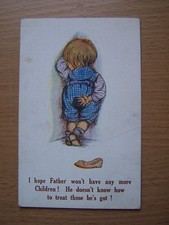
Mrs Bellamy, whose reputation for discipline with her well-worn carpet slipper was known throughout the junior classrooms, quietly dabbed at her eyes with a neatly folded lace handkerchief.
Miss Fenwick stood beside Miss Reed, exchanging the occasional glance but saying very little.
Even Miss Harcourt, the formidable mistress responsible for boarding discipline, remained unusually subdued. Her posture was as straight as ever, her hands folded neatly before her, yet the stern expression she normally wore had softened into something approaching sadness.
There was an unmistakable feeling that an entire chapter in the school’s history was coming to a close.
When the hall had fallen completely silent, Miss Beatrice Blyton stepped onto the platform.
For a few moments she simply stood there, looking across the sea of familiar faces.
Some belonged to children she had taught only a few months.
Others were sisters and brothers of former pupils whose parents she herself had once known.
For thirty-two years she had devoted her life to St Anne’s.
She had taught arithmetic and grammar, corrected untidy handwriting, encouraged nervous children, praised hard work and demanded good manners. She had celebrated successes, comforted disappointments and upheld standards that she believed prepared young people for the responsibilities of adult life.
Like many headmistresses of her generation, she had presided during an age when authority was rarely questioned.
Rules were expected to be obeyed.
Teachers were respected.
Parents generally supported the school’s decisions.
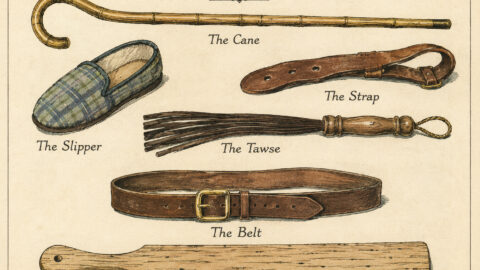
Discipline, whether through stern words, detention, writing lines or, for more serious offences, the cane administered privately in the Headmistress’s study, was considered by most people to be an ordinary part of education rather than something extraordinary.
Yet even Miss Blyton could sense that society beyond the school gates was beginning to change.
Educational journals increasingly spoke of encouragement rather than punishment.
Parents asked more questions than they once had.
Younger teachers discussed new ideas about understanding children rather than simply correcting them.
The old certainties were slowly beginning to shift.
She adjusted her spectacles and addressed the assembled school.
“You will remember many things about St Anne’s,” she began in her calm, measured voice.
“Some of you will remember your lessons and examinations.”
“Some will remember the friendships you have formed within these walls.”
“Some may remember rules, detentions and perhaps one or two visits to my study.”
A gentle ripple of nervous laughter travelled through the hall.
Several older pupils exchanged knowing smiles.
Even a few members of staff could not entirely suppress their amusement.
Miss Blyton herself allowed the faintest hint of a smile before continuing.
“I hope, however, that when you leave this school, you will remember something far more important.”
She paused.
“The purpose of discipline has never been punishment for its own sake.”
“It has always been to help you become men and women capable of governing yourselves.”
She looked slowly across the assembled pupils.
“Discipline is not merely what another person imposes upon you.”
“It is what, in time, you learn to impose upon yourself.”
“If you leave these gates able to choose honesty over convenience, kindness over cruelty, diligence over idleness and responsibility over excuse, then St Anne’s will have succeeded in its purpose.”
Silence filled the hall.
Behind her hung the great carved wooden school crest.
Beneath it, picked out in gold leaf, gleamed the school’s Latin motto.
Per Ordinem ad Sapientiam.
Through Order, Wisdom.
The words seemed to carry even greater significance that morning.
When the assembly concluded, the pupils rose together and applauded.
The applause continued far longer than was customary.
Some teachers openly wiped tears from their eyes.
Others simply stood in respectful silence.
Miss Blyton inclined her head modestly before leaving the platform for the final time.
Without ceremony she walked slowly back along the familiar corridor to her study.
The room was exactly as she had always kept it.
Books stood neatly upon the shelves.
Exercise books waited in carefully stacked piles.
Certificates hung upon the walls.
The polished oak desk occupied its familiar position beside the window overlooking the quadrangle.
For several moments she stood alone in the quiet room.
Then she crossed to the narrow cupboard beside the fireplace.
She unlocked it.
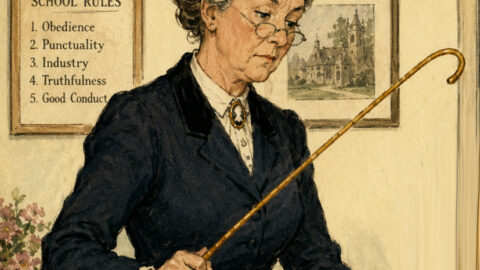
Inside rested two well-polished school canes.
They had occupied that cupboard for many years.
Countless pupils had glanced nervously towards its door when entering the study.
To generations of children they had represented authority itself.
Miss Blyton picked up one of them.
It felt exactly as it always had—light, smooth and perfectly balanced.
For decades she had regarded it simply as another tool of her profession, no different in purpose from a textbook, a ruler or a report book.
Now, however, she found herself wondering whether its time was drawing to a close.
Not because discipline no longer mattered.
Indeed, she believed good discipline would always matter.
But because the methods by which it was achieved were already beginning to change.
She gently returned the cane to its place beside the other.
Closing the cupboard, she turned the key one final time.
Outside her open window came the familiar sound of the last bell of the summer term ringing across the quadrangle.
Moments later, the quiet was replaced by laughter.
Doors opened.
Children spilled from classrooms carrying satchels, cricket bats and straw hats.
Their cheerful voices echoed between the old red-brick buildings as they hurried towards waiting parents, bicycles and the promise of six long weeks of summer freedom.
Miss Blyton watched them disappear into the sunshine.
The school would continue.
Another headmistress would occupy her office.
New teachers would arrive with new ideas.
The traditions of St Anne’s would remain, though perhaps in gentler forms than before.
The cane and the slipper would continue to have their place for a few years yet.
But their unquestioned authority—the certainty with which earlier generations had accepted them—was quietly fading into history.
An age was ending.
Another was patiently waiting beyond the school gates.