It was the autumn term of 1952 when St Anne’s County Grammar School once again opened its imposing black iron gates to welcome another generation of pupils. Nestled on the edge of a quiet Surrey village, surrounded by ancient horse chestnut trees and overlooking rolling green fields, the school possessed an air of respectability that few questioned and even fewer challenged.
Its great red-brick buildings had stood proudly for generations. Tall sash windows overlooked perfectly kept lawns, while long polished corridors echoed with the sound of sensible shoes upon wooden floors. Rising above everything was the old clock tower, whose bell could be heard across the surrounding countryside, faithfully marking the beginning and end of each lesson.
The school grounds were extensive. There were neat playing fields, tennis courts, a chapel, a gymnasium smelling permanently of polish and linseed oil, and boarding houses for pupils whose homes lay too far away for the daily journey. Everything was immaculately maintained, and everything had its proper place.
Originally founded as a girls’ grammar school before the Great War, St Anne’s had reluctantly begun admitting a small number of boys after the Second World War. Even so, the school remained unmistakably under feminine authority. Nearly every classroom was ruled by an experienced mistress whose standards were every bit as high as those of the headmistress herself.
At the very top of this carefully ordered world stood Miss Beatrice Blyton.
Tall, silver-haired and impeccably dressed, Miss Blyton was never seen without her dark tailored suit, polished shoes and the familiar string of pearls resting neatly around her neck. Her calm expression rarely altered, yet a single glance from her could silence an entire assembly hall.
She possessed a quiet authority that needed no raised voice.
Pupils often remarked that one felt compelled to stand a little straighter whenever she entered a room.
Miss Blyton believed, without the slightest hesitation, that education rested upon discipline.
“Without order,” she would often remind both staff and pupils, “there can be no learning.”
Every new pupil received a handbook on their first morning.
Inside were rules that everyone was expected to know by heart.
Uniform was to be immaculate at all times.
Shoes were to shine.
Homework was to be completed promptly.
Talking in corridors was forbidden.
Running anywhere inside the buildings was considered unacceptable.
Teachers were always to be addressed as “Miss” or “Mrs.”
Prefects represented the authority of the school and were to be obeyed without argument.
Leaving the school grounds without permission was regarded as a most serious offence.
These rules were not regarded as helpful guidance.
They were expectations.
Failure to observe them carried consequences.
Behind Miss Blyton’s polished oak desk stood a narrow cupboard that remained locked throughout the day.
Within it rested attendance registers, examination papers, confiscated catapults, comic books, pea shooters and other forbidden treasures collected over many years.
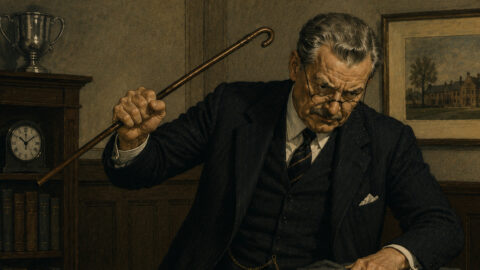
Standing neatly beside them were two well-polished school canes.
Every pupil knew they were there.
Very few ever saw them taken from the cupboard.
None wished to.
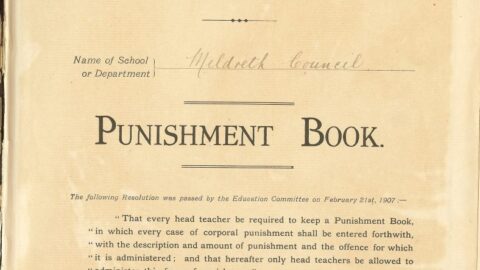
Although the cane was reserved for serious breaches of school discipline and administered only by the headmistress, its very presence seemed to cast a long shadow across the school.
Elsewhere, many of the senior mistresses maintained discipline in their own fashion. Several kept a well-worn gym slipper in a desk drawer, whilst others preferred lengthy detentions, extra lines, or the loss of prized privileges. Most pupils soon discovered that each classroom had its own traditions, and every mistress her own expectations.
There was Miss Eleanor Harcourt, the formidable mathematics mistress, whose silence often proved more intimidating than shouting.
Mrs Margaret Bellamy, mistress of English, carried herself with such dignity that even the liveliest class became remarkably attentive the moment she entered the room.
Miss Edith Pritchard, who taught history, believed punctuality to be one of civilisation’s greatest virtues and tolerated lateness from no one.
Together they formed the backbone of St Anne’s discipline.
At the first staff meeting of every academic year, Miss Blyton would close the register, look steadily around the room and quietly repeat the same words she had spoken for many years.
“A rule that is never enforced,” she would say, “is merely a suggestion.”
Around the long table, heads nodded in quiet agreement.
At St Anne’s County Grammar School, suggestions had never held very much authority.