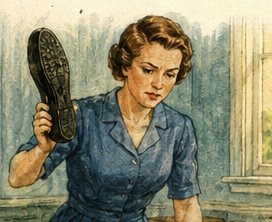
There was a time in small-town America when the school bell did more than mark the beginning and end of class—it marked the rhythm of discipline itself.
In our little junior high in downstate Illinois during the 1970s, corporal punishment wasn’t unusual, controversial, or hidden away. It was simply part of the school day. Every classroom teacher kept a smooth wooden paddle tucked neatly inside a desk drawer, ready should a student’s behavior cross the line. Most offenses were handled quietly in the hallway outside the classroom. More serious cases earned a trip to the principal’s office, where the consequences carried a little more weight—and usually a few more swats.
The sound of a paddle striking its mark was as familiar as the ringing of the class change bell. It echoed through cinderblock hallways and drifted beneath classroom doors, reminding everyone that rules carried consequences. Students rarely spoke about it openly, but everyone listened. The hallway would fall silent for a moment, the sharp reports would ring out, and then lessons resumed as though nothing extraordinary had happened.
It was a Thursday in basketball season, and game days always brought a little extra excitement. The boys on the team proudly wore their warm-up tops to school, while the cheerleaders arrived in matching uniforms that brightened the otherwise ordinary halls—gold sweaters trimmed in navy and white, neatly pressed pleated skirts, knee socks with gold stripes, and polished saddle shoes. School spirit seemed to fill every corner of the building.
That afternoon our eighth-grade English class sat beneath the watchful eye of Ms. Preston, a teacher known for demanding attention and maintaining order. She believed that a classroom worked best when distractions were dealt with immediately. Her paddle had earned a reputation all its own, especially among the boys, though every so often a girl would find herself facing the same consequences.
While Ms. Preston patiently explained the mysteries of diagramming sentences, two classmates, Lisa Haynes and Cindy Doty, were busy exchanging whispered conversations and folded notes. Lisa barely glanced toward the blackboard, seemingly more interested in her friend’s comments than the lesson unfolding before her.
Without warning, Ms. Preston’s voice cut cleanly across the room.
“Miss Haynes! Shut your mouth!”
The room froze.
Then, just as quickly, the lesson continued.
A few minutes later I asked permission to visit the restroom. On my way back, chance placed me at the edge of one of those unforgettable schoolhouse moments.
From the boys’ restroom doorway I noticed Lisa stepping into the hallway, Ms. Preston following closely behind with the familiar wooden paddle in hand. Curiosity overcame better judgment, and I lingered quietly where I could hear—but scarcely be seen.
Lisa pleaded softly, hoping to avoid what seemed inevitable.
Ms. Preston instructed her to face the wall and wait. Then she crossed the hall to another classroom.
“Could you step out for a moment?” she asked Ms. Yarnell. “I’d appreciate a witness.”
Such formalities were common in those days. A second teacher often observed disciplinary paddlings, lending an air of official procedure to what was considered routine school discipline.
The two teachers spoke quietly before returning to where Lisa stood.
“Turn around, Miss Haynes.”
Lisa did, her nervousness plain to see.
Ms. Preston calmly reminded her why they were standing in the hallway at all. The repeated talking, the ignored warning, the disruption of class—each point was delivered like another line in a lesson that had already been decided.
Finally, Ms. Preston concluded with the words every student hoped never to hear.
“You’re going to receive two swats, Miss Haynes.”
In schools across much of America during that era, scenes like this were neither extraordinary nor sensational. They reflected an educational philosophy that believed swift physical punishment corrected misbehavior, restored classroom order, and allowed everyone to move forward. Whether one remembers those days with approval, discomfort, or disbelief, they remain a vivid chapter in the history of American education—a time when authority was measured not only by a teacher’s voice, but by the paddle resting quietly in the desk drawer, waiting for the moment it might once again be called into service.