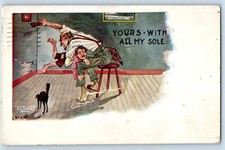
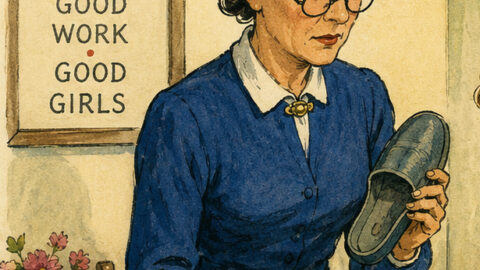
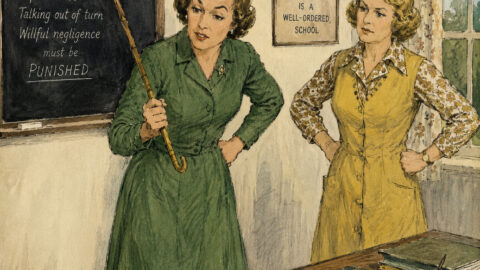
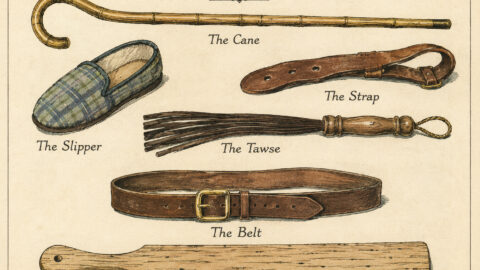
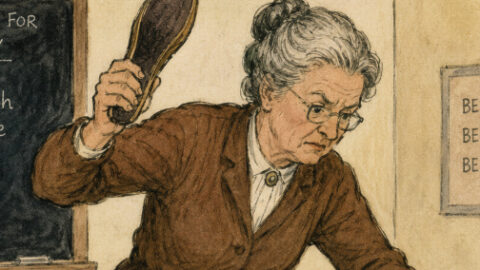
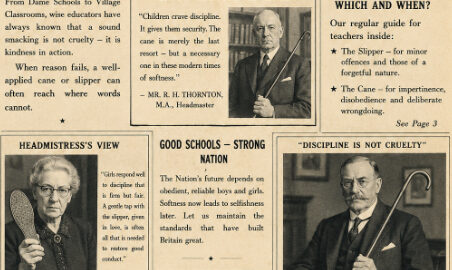
For many years I have taken a keen interest in the history of discipline in English schools, particularly the use of the slipper as a form of corporal punishment. For much of the twentieth century, slipperings formed a familiar part of school life in many primary and secondary schools across England. Although practices varied considerably from one school to another, many pupils regarded the possibility of receiving the slipper as simply another aspect of growing up and attending school.
During that period, respect for teachers and their authority was generally much stronger than it is today. Parents expected schools not only to educate their children but also to instil good manners, discipline, responsibility and respect for others. If a child persistently misbehaved, failed to complete homework, disrupted lessons or behaved disrespectfully, parents often accepted that a teacher might administer a slippering as a disciplinary measure.
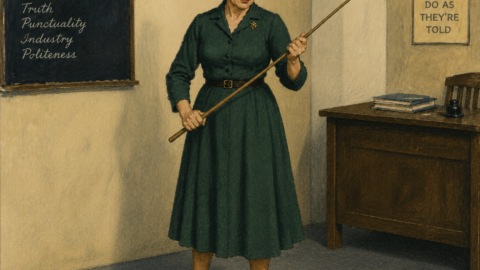
In many schools, most corporal punishment was administered by female teachers, particularly in junior and primary schools where women formed the majority of the teaching staff. Male teachers also used the slipper in some schools, especially in secondary education, but they were less frequently responsible for routine disciplinary punishments. Female teachers were often seen as firm but caring authority figures who maintained orderly classrooms through a combination of encouragement, clear expectations and, when considered necessary, the measured use of the slipper.
Many parents placed enormous trust in these teachers. They believed that female teachers, who spent many hours each day with their children, understood when discipline was genuinely required and would exercise their authority fairly. Some parents even preferred to maintain a more relaxed atmosphere at home, leaving the unpleasant responsibility of enforcing strict discipline to the school. In this way, teachers—predominantly women, though assisted by a smaller number of male colleagues—were regarded as acting in loco parentis, exercising parental authority during the school day.
Supporters of the system argued that slipperings were intended neither as acts of cruelty nor as expressions of anger. Rather, they were seen as brief, memorable punishments designed to reinforce standards of behaviour and discourage repeated misconduct. In many schools, the slipper was used only after warnings or other sanctions had failed. Former pupils often recalled that while they dreaded receiving the punishment, it was usually administered quickly, after which the matter was considered closed and no lasting resentment remained.
Nevertheless, no disciplinary system can depend entirely upon the judgement of individual teachers without the risk of mistakes. Although the great majority of teachers attempted to exercise restraint and fairness, there were occasions when some exceeded acceptable standards. A small number of female teachers, and a smaller number of male teachers, became known for administering punishments that many considered unnecessarily severe or inconsistent. Such incidents attracted increasing public criticism and raised questions about whether physical discipline could ever be applied fairly in every circumstance.
As public attitudes evolved during the latter half of the twentieth century, confidence in corporal punishment steadily declined. Parents who had once accepted slipperings as part of school life became increasingly concerned about the possibility of excessive or inappropriate punishment. Greater public awareness of children’s welfare, together with changing educational philosophies, encouraged many people to question whether physical discipline still had a place in modern education.
In my view, the greatest weakness of school corporal punishment was never simply the punishment itself but the unavoidable reliance upon the judgement and self-control of the individual teacher. Even a system administered responsibly by the overwhelming majority could lose public confidence because of the actions of a relatively small minority. Trust, once damaged, proved exceptionally difficult to restore.
This loss of confidence ultimately transformed the relationship between parents and teachers. There was once widespread acceptance that teachers acted in loco parentis, exercising authority on behalf of parents during the school day. As society changed, however, many parents became less willing to delegate that authority, and schools themselves increasingly moved towards disciplinary approaches based upon counselling, behaviour management and restorative practices rather than physical correction.
For these reasons, I believe it is extremely unlikely that slipper punishment will ever return to English schools. Legal protections, professional standards and public expectations have changed fundamentally. Most people today consider any form of physical punishment by teachers to be unacceptable regardless of the circumstances, while schools have developed a wide range of alternative methods for maintaining discipline.
This does not mean that the earlier system was without supporters or that every teacher who administered a slippering acted improperly. On the contrary, many teachers—predominantly women and supported by a smaller number of male colleagues—were remembered by former pupils as conscientious professionals who used corporal punishment sparingly, calmly and with what they believed to be the pupils’ long-term interests in mind.
Equally, however, it cannot be denied that some teachers abused the authority entrusted to them. Whenever any disciplinary power rests in human hands, there is always the possibility that a minority will misuse it through poor judgement, excessive severity or personal temperament. Such conduct deserved criticism and inevitably undermined public confidence in the wider system.
Some supporters of corporal punishment argued that the misconduct of a minority should not automatically condemn the entire practice. They maintained that in many areas of society, abuses are addressed through regulation and accountability rather than outright prohibition. Whether one agrees with that comparison or not, it reflects a broader historical debate: whether the problem lay in corporal punishment itself or in ensuring that only teachers possessing fairness, restraint and sound professional judgement were ever entrusted with its use.
Whatever one’s conclusions, the history of slipper punishment in English schools provides a revealing insight into changing attitudes towards authority, education and childhood. It illustrates how standards once regarded as entirely normal can, within a generation or two, come to be viewed in a completely different light as society’s values evolve.