By the beginning of November, a cold mist settled over the Sussex countryside each morning, wrapping Highdon School in a blanket of silver that lingered until almost lunchtime.
The old brick buildings looked even older beneath the grey sky.
From the windows of Ash House, the boys watched rooks circling above the chapel tower while the first frosts whitened the rugby pitches.
Life at Highdon continued with its familiar rhythm.
The rising bell sounded before dawn.
Lessons began precisely on time.
Chapel remained compulsory.
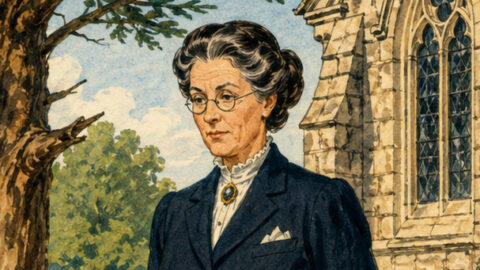
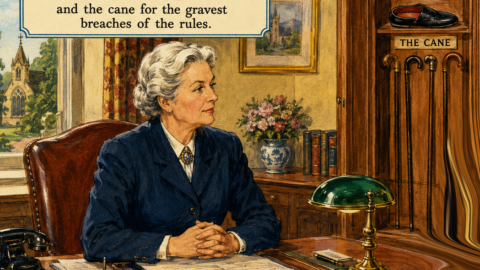
Above everyone stood the formidable Headmistress, Miss Bowflower, a tall, grey-haired lady whose calm voice carried far more authority than shouting ever could. She believed that kindness and encouragement came first, but she also believed that discipline must never be allowed to slip.
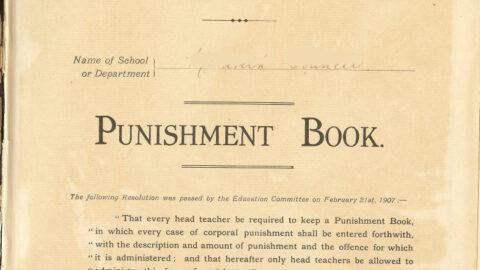
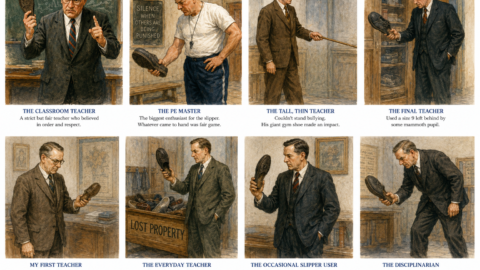
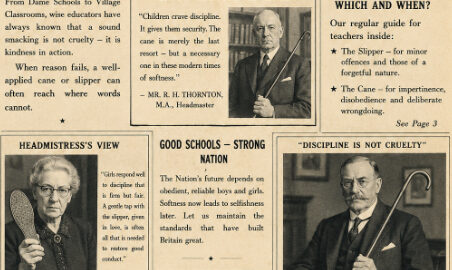
Throughout the school it was well known that serious breaches of discipline could still result in traditional punishment. Minor offences were often dealt with by one of the housemistresses using the familiar rubber-soled carpet slipper, usually after repeated warnings had been ignored. More serious acts of dishonesty, bullying or deliberate defiance were referred directly to Miss Bowflower herself.
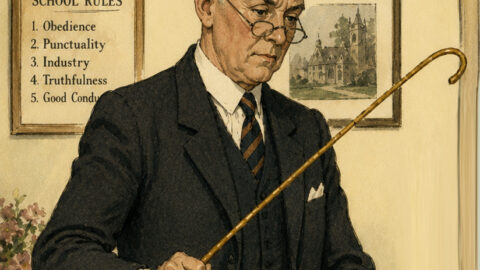
In the cabinet beside her study stood several slender school canes, carefully polished and hanging from brass hooks. Resting neatly in the top drawer of her desk was an old black carpet slipper with a red rubber sole, used far more often than the canes. Neither implement was displayed for effect alone. Every boy knew they formed part of the discipline that Highdon had followed for generations, and Miss Bowflower expected them to be respected rather than feared.
Visitors occasionally remarked that Highdon seemed to belong to another age. The traditions of the school remained remarkably unchanged, even as many other schools across Britain quietly abandoned such practices. Miss Bowflower often reminded both staff and pupils that discipline was intended to uphold the standards of the school, never to replace fairness or good judgement.
For David Mercer, however, there were far more exciting matters to think about.
He could think of little except the diary they had discovered beneath the old cedar tree.
Every spare moment found the four friends searching for another opportunity to visit the hidden passage.
Late one Wednesday afternoon, after rugby practice had ended, they returned carrying fresh batteries for their torch.
This time they ventured farther than before.
The narrow tunnel twisted gently before opening unexpectedly into a small brick chamber.
Dust lay thick upon the floor.
Cobwebs stretched from wall to wall.
Against one side stood an old oak chest, its brass fittings tarnished almost black with age.
Peter brushed away years of dust.
“It hasn’t been opened for ages,” he whispered.
Together they lifted the heavy lid.
Inside they found no buried treasure.
Instead they discovered bundles of carefully tied exercise books, faded photographs, old school magazines and a leather folder marked simply:
Highdon Archives
Simon opened one of the magazines.
Its pages contained reports of cricket matches played before the First World War, dramatic productions, prize-giving speeches and accounts of expeditions across the South Downs.
Another notebook proved even more interesting.
It had belonged to the school’s founder.
His neat handwriting described his hopes for Highdon.
He wrote of scholarship, honesty, courage and friendship.
Again and again he returned to one central thought.
“A school is remembered not for its buildings, but for the character of those who pass through its gates.”
The four boys sat quietly for several moments.
It felt strange to read words written nearly a century earlier by the man who had created Highdon itself.
Above them, muffled by earth and stone, the chapel bell sounded faintly.
“We’d better put everything back exactly as we found it,” David said.
Carefully they replaced every notebook, every photograph and every document before lowering the heavy lid once more.
As they climbed back into the fading afternoon light, brushing leaves from their jackets, they stopped abruptly.
Standing quietly beside the ancient cedar tree was Miss Bowflower.
No one spoke.
The Headmistress looked steadily from one anxious face to another before glancing at the disturbed leaves covering the hidden entrance.
Then, to their complete surprise, she smiled.
“I wondered how long it would be before someone rediscovered that passage,” she said quietly.
The boys stared at her.
“You… knew about it?” Andrew asked.
“Oh yes,” replied Miss Bowflower. “I discovered it myself when I was a young teacher at Highdon.”
For a moment none of them knew what to say.
Instead of ordering them straight to her study—where every boy knew the black slipper rested in the top drawer and the polished canes stood ready in the cupboard for the gravest offences—she simply beckoned them to follow.
“Come with me.”
She led them across the quadrangle and into the school library.
There she unlocked a tall glass-fronted cabinet.
Inside were medals, photographs, school colours and carefully preserved documents recording the history of Highdon through the generations.
“You have uncovered part of our school’s past,” she said. “History deserves curiosity—but it also deserves care.”
The boys nodded earnestly.
“You may continue your research,” she continued, “provided you always do so safely and tell me what you discover. Highdon’s traditions are worth preserving.”
Relief swept over all four boys.
Instead of punishment, they had been trusted.
As they left the library, David could scarcely believe their good fortune.
Somewhere beneath the ancient chapel, the forgotten passages of Highdon still concealed mysteries waiting to be uncovered, and now, with Miss Bowflower’s knowledge and permission, the adventure had only just begun.