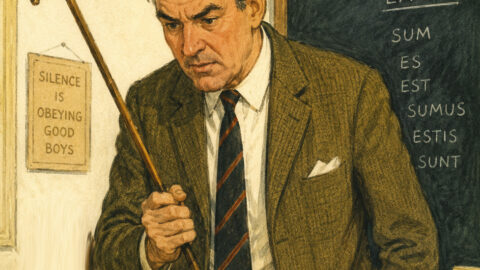
For many former pupils, the subject of corporal punishment in Scottish schools evokes vivid memories. Until its abolition in 1987, the tawse—or “the belt,” as it was commonly known—remained a familiar feature of school discipline across much of Scotland. While attitudes towards it varied considerably, it is clear that the practice persisted widely right up until the final years before it was banned, despite growing public debate and official recommendations aimed at restricting its use.
Whether corporal punishment was still being used enthusiastically in every school by the mid-1980s is difficult to determine. Practices differed between local authorities, individual schools and, most significantly, individual teachers. Some schools had already begun reducing its use, while others continued to rely on it as a routine disciplinary measure until abolition.
The Psychology Behind the Memory
One of the most interesting aspects of corporal punishment is that memories of it are often shaped as much by the circumstances surrounding the punishment as by the physical pain itself.
Looking back, the most distressing punishment I experienced was not the hardest physically. Even after receiving six strokes from my male headmaster during secondary school, the punishment that remained most vivid in my memory was six strokes with a John Dick tawse administered by my female primary school headmistress.
The reason, I believe, had little to do with the severity of the strokes themselves. Rather, it was the emotional circumstances that accompanied them. The headmistress was visibly angry, and her anger made the entire experience far more intimidating. The atmosphere was tense, personal and emotionally charged.
By comparison, several other punishments I received from female class teachers and another female deputy head were delivered in a calm, matter-of-fact manner. There was no shouting or visible anger. Those teachers appeared simply to be carrying out what they regarded as part of maintaining discipline. I had been an energetic and sometimes disruptive child—what would probably now be recognised as hyperactivity—and I generally understood why I was being punished.
Another important difference was the relationship I had with the teachers involved. Most of those who punished me were people I liked, respected or at least trusted. Although the punishment itself was unpleasant, I accepted that I had broken the rules.
The incident involving the headmistress felt entirely different. I believed the punishment was unjustified, and because I felt wrongly accused, the experience remained emotionally significant long after the physical pain had disappeared.
This illustrates an important point about childhood memory. It is often not simply the punishment itself that leaves the deepest impression, but the feelings surrounding it: whether the child believed it was fair, whether the teacher appeared calm or angry, and whether there was an existing relationship of trust or fear.
The 1968 Guidance and Classroom Reality
In 1968, official recommendations sought to limit the circumstances in which the tawse should be used. Among the most significant was the advice that corporal punishment should not be administered simply because a pupil had performed poorly in academic work.
However, the practical effect of these recommendations appears to have been limited in many schools.
My significant other taught in Scottish schools, both in the state sector and later in independent schools, before corporal punishment was abolished. Like many teachers of the period, she carried and occasionally used the tawse as part of the disciplinary system.
She recalled that although the professional teaching bodies endorsed the guidance, many teachers continued to follow their established disciplinary practices. Personally, she would never have used the tawse to punish poor academic performance or incorrect classroom work, believing that such matters should be addressed through teaching rather than punishment. Nevertheless, she knew many colleagues—again, predominantly female teachers—who continued to use the tawse for classroom work despite the official recommendations discouraging the practice.
As with many aspects of school discipline, individual teachers exercised considerable discretion, resulting in significant differences between schools and even between classrooms within the same school.
Public Punishment and Pupil Behaviour
An interesting question is how pupils behaved when punishment was administered publicly.
Some children became quiet and compliant, while others attempted to hide embarrassment by making jokes or acting defiantly in front of their classmates. Such bravado rarely reflected genuine confidence. More often it was an attempt to preserve dignity among friends before the reality of the punishment took effect.
Because the tawse was capable of causing immediate and considerable pain, repeated public punishments often became memorable events witnessed by many pupils. Even those who never received the tawse themselves were frequently aware of its presence simply by observing classmates being punished.
Teachers Beyond the Classroom
One feature that distinguished many Scottish schools was that discipline was not confined to individual classrooms. Responsibility for maintaining order extended throughout the school building and grounds.
Many teachers—predominantly female, reflecting the staffing balance in many primary and lower secondary schools of the period—carried their tawse while on supervisory duty. Some carried it looped in one hand, while others slipped it over a shoulder beneath a jacket, making it readily available if needed.
Teachers assigned to corridor duty supervised pupils during class changes, break times and the beginning and end of the school day. They watched for running in corridors, excessive noise, pushing, dangerous behaviour on staircases, and general disorder.
If a pupil was caught breaking the rules, the teacher might stop them immediately. In some schools the punishment was administered on the spot, often in view of other pupils. In others, the child would be escorted to a nearby office or empty classroom before receiving the tawse.
Schools also organised patrols to supervise toilets, primarily to discourage smoking, vandalism or groups of pupils avoiding lessons. Those found misbehaving could expect immediate disciplinary action.
Playground supervision operated in much the same way. Teachers monitored fights, rough play, dangerous games, footballs striking windows, climbing on buildings and pupils entering areas reserved for other year groups. Depending on school policy, punishment might be given immediately outside or shortly afterwards inside the building.
“Belting the Lates”
One practice remembered by many former Scottish pupils was the routine punishment of late arrivals.
School doors commonly closed shortly before lessons began, often around 8.50 a.m. Pupils arriving after this time were kept waiting inside the entrance until registration had begun.
Groups of latecomers would then be lined up and dealt with in turn. In many schools, female teachers supervised the girls’ entrance while a smaller number of male teachers dealt with boys arriving through their entrance. Excuses were rarely accepted unless there was a particularly compelling reason for the lateness.
For many children this became an accepted, if dreaded, part of school life. The expectation that lateness would almost automatically result in corporal punishment encouraged punctuality but also generated considerable anxiety among pupils who faced unavoidable delays.
Scotland and England Compared
Although corporal punishment existed in both Scotland and England, many former pupils believe that Scotland retained a stronger and more routine culture of using the tawse for everyday disciplinary matters.
In England, punishment was often more closely associated with the slipper or cane and was frequently reserved for more serious offences, depending on the school. In Scotland, by contrast, the tawse was deeply embedded in daily school discipline and could be used for a much wider range of misdemeanours, from disorderly behaviour to repeated lateness.
Experiences nevertheless varied enormously. Much depended upon the philosophy of the headteacher and the temperament of individual teachers. Some relied heavily on corporal punishment, while others used it only sparingly, preferring verbal correction or other disciplinary methods.
Looking Back
Today, opinions remain divided. Some former pupils believe the tawse maintained discipline and reflected the standards of its time, while others remember it as a source of fear, humiliation or injustice.
What is beyond doubt is that memories of corporal punishment are shaped by far more than the physical act itself. The fairness of the punishment, the relationship between teacher and pupil, the emotional atmosphere in which it was administered, and the wider culture of the school all played powerful roles in determining how those experiences have been remembered decades later.
For many former pupils, the subject of corporal punishment in Scottish schools evokes vivid memories. Until its abolition in 1987, the tawse—or “the belt,” as it was commonly known—remained a familiar feature of school discipline across much of Scotland. While attitudes towards it varied considerably, it is clear that the practice persisted widely right up until the final years before it was banned, despite growing public debate and official recommendations aimed at restricting its use.
Whether corporal punishment was still being used enthusiastically in every school by the mid-1980s is difficult to determine. Practices differed between local authorities, individual schools and, most significantly, individual teachers. Some schools had already begun reducing its use, while others continued to rely on it as a routine disciplinary measure until abolition.
The Psychology Behind the Memory
One of the most interesting aspects of corporal punishment is that memories of it are often shaped as much by the circumstances surrounding the punishment as by the physical pain itself.
Looking back, the most distressing punishment I experienced was not the hardest physically. Even after receiving six strokes from my male headmaster during secondary school, the punishment that remained most vivid in my memory was six strokes with a John Dick tawse administered by my female primary school headmistress.
The reason, I believe, had little to do with the severity of the strokes themselves. Rather, it was the emotional circumstances that accompanied them. The headmistress was visibly angry, and her anger made the entire experience far more intimidating. The atmosphere was tense, personal and emotionally charged.
By comparison, several other punishments I received from female class teachers and another female deputy head were delivered in a calm, matter-of-fact manner. There was no shouting or visible anger. Those teachers appeared simply to be carrying out what they regarded as part of maintaining discipline. I had been an energetic and sometimes disruptive child—what would probably now be recognised as hyperactivity—and I generally understood why I was being punished.
Another important difference was the relationship I had with the teachers involved. Most of those who punished me were people I liked, respected or at least trusted. Although the punishment itself was unpleasant, I accepted that I had broken the rules.
The incident involving the headmistress felt entirely different. I believed the punishment was unjustified, and because I felt wrongly accused, the experience remained emotionally significant long after the physical pain had disappeared.
This illustrates an important point about childhood memory. It is often not simply the punishment itself that leaves the deepest impression, but the feelings surrounding it: whether the child believed it was fair, whether the teacher appeared calm or angry, and whether there was an existing relationship of trust or fear.
The 1968 Guidance and Classroom Reality
In 1968, official recommendations sought to limit the circumstances in which the tawse should be used. Among the most significant was the advice that corporal punishment should not be administered simply because a pupil had performed poorly in academic work.
However, the practical effect of these recommendations appears to have been limited in many schools.
My significant other taught in Scottish schools, both in the state sector and later in independent schools, before corporal punishment was abolished. Like many teachers of the period, she carried and occasionally used the tawse as part of the disciplinary system.
She recalled that although the professional teaching bodies endorsed the guidance, many teachers continued to follow their established disciplinary practices. Personally, she would never have used the tawse to punish poor academic performance or incorrect classroom work, believing that such matters should be addressed through teaching rather than punishment. Nevertheless, she knew many colleagues—again, predominantly female teachers—who continued to use the tawse for classroom work despite the official recommendations discouraging the practice.
As with many aspects of school discipline, individual teachers exercised considerable discretion, resulting in significant differences between schools and even between classrooms within the same school.
Public Punishment and Pupil Behaviour
An interesting question is how pupils behaved when punishment was administered publicly.
Some children became quiet and compliant, while others attempted to hide embarrassment by making jokes or acting defiantly in front of their classmates. Such bravado rarely reflected genuine confidence. More often it was an attempt to preserve dignity among friends before the reality of the punishment took effect.
Because the tawse was capable of causing immediate and considerable pain, repeated public punishments often became memorable events witnessed by many pupils. Even those who never received the tawse themselves were frequently aware of its presence simply by observing classmates being punished.
Teachers Beyond the Classroom
One feature that distinguished many Scottish schools was that discipline was not confined to individual classrooms. Responsibility for maintaining order extended throughout the school building and grounds.
Many teachers—predominantly female, reflecting the staffing balance in many primary and lower secondary schools of the period—carried their tawse while on supervisory duty. Some carried it looped in one hand, while others slipped it over a shoulder beneath a jacket, making it readily available if needed.
Teachers assigned to corridor duty supervised pupils during class changes, break times and the beginning and end of the school day. They watched for running in corridors, excessive noise, pushing, dangerous behaviour on staircases, and general disorder.
If a pupil was caught breaking the rules, the teacher might stop them immediately. In some schools the punishment was administered on the spot, often in view of other pupils. In others, the child would be escorted to a nearby office or empty classroom before receiving the tawse.
Schools also organised patrols to supervise toilets, primarily to discourage smoking, vandalism or groups of pupils avoiding lessons. Those found misbehaving could expect immediate disciplinary action.
Playground supervision operated in much the same way. Teachers monitored fights, rough play, dangerous games, footballs striking windows, climbing on buildings and pupils entering areas reserved for other year groups. Depending on school policy, punishment might be given immediately outside or shortly afterwards inside the building.
“Belting the Lates”
One practice remembered by many former Scottish pupils was the routine punishment of late arrivals.
School doors commonly closed shortly before lessons began, often around 8.50 a.m. Pupils arriving after this time were kept waiting inside the entrance until registration had begun.
Groups of latecomers would then be lined up and dealt with in turn. In many schools, female teachers supervised the girls’ entrance while a smaller number of male teachers dealt with boys arriving through their entrance. Excuses were rarely accepted unless there was a particularly compelling reason for the lateness.
For many children this became an accepted, if dreaded, part of school life. The expectation that lateness would almost automatically result in corporal punishment encouraged punctuality but also generated considerable anxiety among pupils who faced unavoidable delays.
Scotland and England Compared
Although corporal punishment existed in both Scotland and England, many former pupils believe that Scotland retained a stronger and more routine culture of using the tawse for everyday disciplinary matters.
In England, punishment was often more closely associated with the slipper or cane and was frequently reserved for more serious offences, depending on the school. In Scotland, by contrast, the tawse was deeply embedded in daily school discipline and could be used for a much wider range of misdemeanours, from disorderly behaviour to repeated lateness.
Experiences nevertheless varied enormously. Much depended upon the philosophy of the headteacher and the temperament of individual teachers. Some relied heavily on corporal punishment, while others used it only sparingly, preferring verbal correction or other disciplinary methods.
Looking Back
Today, opinions remain divided. Some former pupils believe the tawse maintained discipline and reflected the standards of its time, while others remember it as a source of fear, humiliation or injustice.
What is beyond doubt is that memories of corporal punishment are shaped by far more than the physical act itself. The fairness of the punishment, the relationship between teacher and pupil, the emotional atmosphere in which it was administered, and the wider culture of the school all played powerful roles in determining how those experiences have been remembered decades later.