If there was one lesson that many former pupils agreed upon, it was that the severity of corporal punishment often depended less upon the implement being used and far more upon the person holding it.
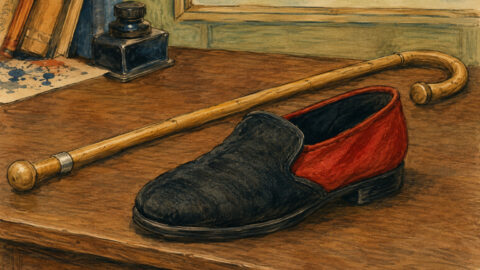
A cane in the hands of one teacher might result in little more than a sharp sting and a few red marks. In the hands of another, it became something children dreaded for days. The same was true of the slipper. Two teachers could use identical gym shoes, yet the experience could be completely different.
As children, pupils quickly learned which teachers to avoid.
Some teachers rarely punished anyone. A stern look or a quiet word was usually enough to restore order. Others had reputations that travelled through the playground faster than any official school announcement. New pupils soon discovered which classrooms held the strictest discipline and which teachers were known for their willingness to use the slipper, ruler or cane.
Many people who later reflected upon their school years believed there was a noticeable difference between male and female teachers.
The male teachers were often physically stronger and could deliver particularly forceful strokes, especially with the cane. Yet many former pupils recalled that female teachers seemed to possess remarkable precision. Rather than relying on strength alone, they knew exactly where and how to strike to produce maximum effect.
Several remembered female teachers as being every bit as strict as their male colleagues.
One former pupil, who experienced corporal punishment throughout both primary and secondary school, believed that many of the female teachers actually administered harder slipperings than the men. It was not simply his opinion. Many of the boys he knew felt exactly the same. Whether this reflected the determination of those teachers or merely the children’s perception is impossible to know, but it became part of school folklore.
Secondary school brought new comparisons.
The same pupil was caned by both his Headmistress and the Associate Headmaster. Looking back, he found it difficult to say whether one punished more severely than the other. The Headmistress administered some of his hardest canings, while one of the Associate Headmaster’s punishments felt almost symbolic—a reminder of authority rather than an attempt to inflict real pain.
His conclusion surprised even him.
The difference was not necessarily between male and female teachers.
It was between individuals.
Every teacher had their own style.
Every punishment reflected their own personality.
Another former pupil explained that in his primary school, punishment followed an unwritten hierarchy.
Minor offences usually resulted in a ruler across the hands or a slap on the legs. More serious misbehaviour might earn a visit to the Headmaster’s office and the dreaded slipper. The cane was reserved for only the gravest offences and was rarely seen by most pupils.
This made every punishment seem unpredictable.
Children spent an entire school year with the same class teacher, and discipline often reflected that teacher’s personality, mood and patience. Some teachers were calm and consistent. Others appeared capable of reacting very differently to identical offences.
One pupil remembered that inconsistency more vividly than anything else.
He felt that punishments were not always measured by what a child had done but sometimes by how the teacher happened to feel that day. A noisy class after lunch, a difficult morning or a frustrating lesson could all influence how severely discipline was administered.
Whether this was genuinely the case or merely how it appeared through a child’s eyes is impossible to know.
What is certain is that many children believed it.
One woman vividly recalled her first punishment at infant school when she was only six years old.
The Head of the Infants summoned her into the office, lifted her over her knee and smacked her firmly on the backside.
Today she remembers very little of the pain itself.
Instead, she remembers the overwhelming sense of injustice.
She had trusted adults completely until that moment. Afterwards she realised that teachers, like everyone else, could sometimes make mistakes, misunderstand situations or simply judge matters differently from the children involved.
It was a lesson that remained with her for the rest of her life.
As pupils grew older and moved into the junior school, discipline often became more formal.
The boys and girls were separated into different parts of the Victorian school building, rarely seeing one another during the day. Rumours circulated constantly.
The boys heard stories that the girls’ Headmistress kept a cane hidden in her office.
Whether it was ever actually used, nobody seemed to know.
Like many school legends, the mystery probably became more frightening than the reality itself.
The ruler, however, was very real.
Music teachers frequently used it across the knuckles, particularly when children failed to pay attention or struggled to follow instructions. Although rarely regarded as severe punishment, a misplaced strike could catch the edge of a finger and produce an unexpectedly sharp pain.
Other teachers preferred different methods entirely.
One class teacher became remembered for making pupils roll down their knee-length socks before bringing the ruler smartly across the backs of their legs. On other occasions she would call children to the front of the classroom, instruct them to roll up a sleeve and then deliver several hard slaps to the exposed arm while the entire class watched.
It was not only the physical pain that stayed in the memory.
Standing before classmates while waiting for each blow often proved equally uncomfortable.
Children standing further back in the queue could watch the teacher’s expression, trying to judge how angry she was becoming with each successive pupil. By the time their own turn arrived, the anticipation could be almost unbearable.
Years later, many former pupils found themselves remembering not simply the punishments themselves, but the remarkable variety of personalities who administered them.
Some teachers appeared almost reluctant to punish, treating corporal punishment as an unfortunate duty required by the standards of the time.
Others seemed to carry an air of complete authority, leaving children in little doubt that discipline formed an essential part of education.
Whatever their approach, they left memories that, for many, remained astonishingly vivid decades after the school bells had finally fallen silent.