Few educational practices now appear more unnecessary than the attempt to force naturally left-handed children to use their right hand.
Yet within living memory the practice was far from unusual.
One former pupil remembers arriving at school and instinctively catching a rubber ball thrown by Sister Agnes Mary with his left hand.
The school desks had been designed principally for right-handed children, and the availability of suitable left-handed desks was limited.
He was therefore encouraged to use his right hand.
His father had suffered similar treatment a generation earlier. Despite having his left hand restrained during lessons, he remained stubbornly left-handed throughout his life.
His mother was determined that her own son should not endure the same experience.
If necessary, she said, she would transfer him to another school.
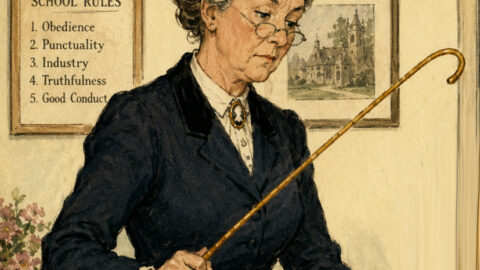
In another English school, Mrs Mildred Foster, an elderly teacher, was remembered for being particularly insistent upon right-handed writing. A pupil who attempted to write with his left hand could expect immediate correction.
Other children were simply watched closely.
If they reverted to the left hand, Miss Patricia Evans might require them to remain in the classroom during playtime practising handwriting with the right.
Why schools were so determined to interfere with handedness is difficult to establish.
There were practical considerations. Desks, ink wells, scissors and other equipment were generally manufactured for the majority, who were right-handed.
Some people may genuinely have believed that a child would encounter fewer difficulties in adult life if trained to conform.
Older superstition may also have played a part. The left side possessed unfortunate associations in European folklore, and words connected with left-handedness occasionally carried sinister meanings.
Whatever the explanation, the educational consequences could be considerable.
A child who had already begun developing coordination with one hand suddenly found herself expected to perform complicated tasks with the other.
Some pupils temporarily wrote backwards.
Others developed awkward or almost illegible handwriting.
One former pupil believes that his poor penmanship and lack of confidence in drawing can partly be traced to those early attempts to alter his natural handedness.
Ironically, several of those subjected to the process became ambidextrous.
Modern observation has also suggested that left-handedness is associated with no intellectual deficiency whatever. Indeed, large numbers of successful scientists, engineers, artists and other professional people are naturally left-handed.
The entire business now appears a striking example of education attempting to solve a problem which did not really exist.
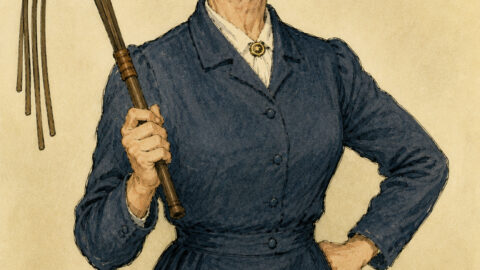
Yet it should perhaps be remembered that the women enforcing these rules — teachers such as Mrs Foster, Miss Evans and Sister Agnes Mary — were themselves products of the educational assumptions of their time.
Most probably believed that they were helping rather than hindering their pupils.
That does not make the practice wise.
It does remind us, however, that yesterday’s educational certainty can become tomorrow’s absurdity.
The same lesson may be drawn from another strange classroom object which survived in parts of nineteenth-century Wales.
It consisted simply of a small wooden board bearing two letters:
W.N.
They stood for “Welsh Not”.
And for the unfortunate child required to wear it, those two letters could make the school day very long indeed.