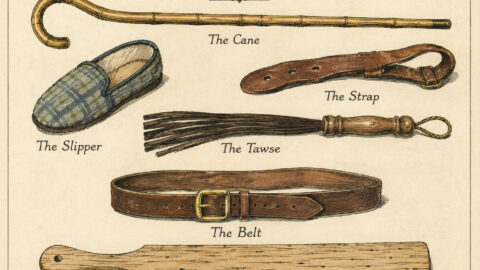
Teachers sometimes spoke of punishment not merely as a means of stopping misconduct but as a means of developing character.
The survey evidence permits us to examine that claim cautiously.
Learning Consequences
At its simplest, punishment taught that actions had consequences.
A pupil who knowingly broke a rule discovered that the school would respond.
Many respondents appear to have accepted this principle.
Responsibility
Some former pupils openly acknowledged that they had deserved punishment.
Such recollections suggest that discipline could reinforce personal responsibility.
The pupil could look back and recognise:
I made the decision; the consequence followed.
But Character Is More Complicated
It would be much harder to demonstrate that corporal punishment itself produced honesty, responsibility or self-discipline.
A pupil might obey because he feared being caught rather than because his character had changed.
The Regular Offender
Repeated offenders present the obvious difficulty.
If punishment automatically improved character, repeated punishment should eventually have produced exemplary behaviour.
The survey plainly shows that this did not always happen.
The Fair Teacher
The adult example may have mattered as much as the punishment.
A teacher who listened, acted consistently and treated pupils fairly demonstrated qualities which pupils could respect.
A teacher perceived as arbitrary could teach a very different lesson.
Discipline as Education
The strongest disciplinary system may therefore have been one in which the pupil understood why a rule existed.
The headmaster explaining the danger of horseplay on a staircase was doing more than threatening punishment.
He was providing a reason.
Character Cannot Be Measured in Strokes
The survey can tell us whether a pupil repeated an offence.
It cannot tell us precisely what kind of adult that pupil became because of a school punishment.
Claims about character formation must therefore remain cautious.
Behaviour can be recorded.
Character is much more difficult to measure.