The survey contains references to an extraordinary variety of implements.
The cane was perhaps the most famous, but it was certainly not alone.
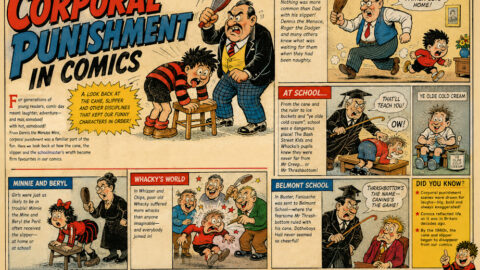
Former pupils recall the slipper, gym shoe, ruler, strap, tawse, stick and, outside Britain particularly, the paddle.
The existence of so many implements illustrates the absence of any single national system of corporal punishment.
Each school developed its own traditions.
The Cane
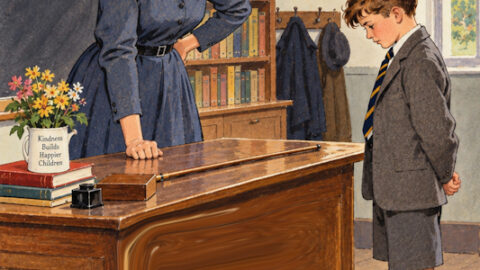
The cane acquired the greatest symbolic importance.
It was commonly associated with serious punishment and senior authority.
A pupil might receive the slipper from an ordinary teacher but be sent to the headmaster for the cane.
Consequently, the words “sent for the cane” often carried a significance beyond the physical punishment itself.
Canes also differed.
Their length, thickness and flexibility could vary, as could the force with which individual teachers used them.
For this reason it is impossible to establish the severity of a caning simply from the number of strokes recorded.
The Slipper
The slipper was less formal but probably more familiar to many pupils.
Again, the name is misleading.
The school “slipper” was frequently a gym shoe or plimsoll rather than a soft domestic slipper.
Physical education teachers had such footwear readily available, and numerous recollections associate the slipper particularly with gymnasiums and changing rooms.
It could also be kept by classroom teachers specifically for disciplinary purposes.
Because the slipper was often employed immediately, it became closely associated with everyday misbehaviour.
Talking, fooling about, failing to follow instructions and minor insolence could result in a few strokes and an immediate return to lessons.
The Ruler
The ruler represented perhaps the simplest disciplinary implement of all.
It was already present in the classroom.
Some contributors remember rulers being used across the hand, knuckles or legs, particularly with younger pupils.
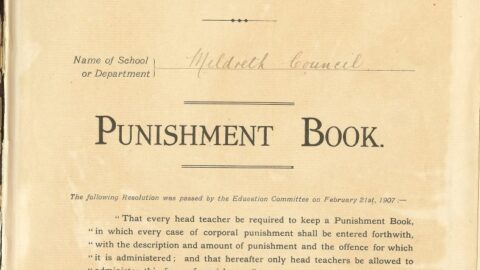
As with the slipper, its use might never appear in an official punishment book.
A teacher could administer a stroke and continue the lesson within seconds.
The Strap and Tawse
The strap was another important implement, particularly for the hands.
In Scotland the tawse developed a particularly strong association with school discipline.
The basic principle was similar: a leather implement was brought down upon the extended hand.
Yet straps varied considerably in design, weight and material.
Consequently, recollections differ as to their severity.
Comparing Implements
Former pupils inevitably compared the punishments they experienced.
One might consider the slipper preferable to the cane. Another might particularly dislike punishment on the hands. A third might remember a certain teacher’s strap as worse than another master’s cane.
Such comparisons are subjective but valuable.
They demonstrate that children did not experience “corporal punishment” as a single uniform penalty.
They experienced particular teachers using particular implements in particular ways.
This distinction must be preserved.
A statistical statement that fifty pupils were corporally punished tells us comparatively little.
Were they given one stroke with a ruler?
Three strokes with a slipper?
Six with a cane?
Were they eleven years old or seventeen?
Was the punishment public or private?
The details transform the meaning of the statistic.
Thus the survey repeatedly returns to the same conclusion: corporal punishment cannot properly be understood merely by counting occasions.
The method mattered.
The circumstances mattered.
And, perhaps most importantly, the teacher administering it mattered.