The material examined so far permits a substantial provisional picture of school corporal punishment during the period covered by this study.
It is a picture characterised above all by diversity.
No Single British Practice
There was no single method uniformly applied throughout the country.
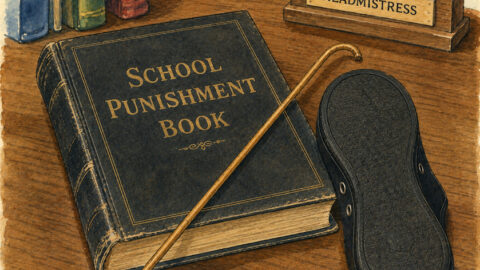
The cane, slipper, strap and Scottish belt all appear.
Some schools punished the hand.
Others followed different traditions.
Some punishment occurred privately.
Some took place before classmates.
No Single Authority
Nor was corporal punishment exclusively the responsibility of the headmaster.
Headmistresses, deputy heads, senior mistresses, housemasters, heads of department and ordinary classroom teachers all appear in the evidence.
The distribution of authority depended upon the school.
No Single Offence
Corporal punishment could be used for misconduct ranging from talking and running to fighting, smoking, truancy, theft and persistent neglect of work.
The same offence could attract different penalties in different schools.
No Single Level of Severity
One or two strokes could constitute a minor punishment.
Three or four were common in many accounts.
Six often represented a serious penalty.
Higher numbers occur, but less frequently in the British period evidence examined here.
Numbers alone, however, cannot adequately measure severity.
No Single Result
Most importantly, there was no single outcome.
Some pupils were deterred.
Some were deterred temporarily.
Some stopped one offence but committed others.
Some became accustomed to punishment.
Some remembered the experience as deserved.
Others remembered injustice.
The Importance of Context
Every useful account therefore requires context:
Who was the pupil?
How old was he or she?
What was the offence?
Had warnings already been given?
Who administered the punishment?
Was it public or private?
Was the pupil punished again?
Did the pupil believe the decision fair?
Without these details, a simple statement that somebody “was caned at school” tells us surprisingly little.
The Purpose of the Survey
This is precisely why the survey questionnaire asks for detail.
Its purpose is not merely to collect stories of punishment.
It is to reconstruct a disciplinary system.
The individual recollections become historically useful when they are compared.
Patterns then begin to appear.
So do exceptions.
Both matter.
The resulting picture is less simple than popular memory sometimes suggests, but it is also considerably more informative.
Corporal punishment was neither one uniform institution nor a collection of completely unrelated incidents.
It was a family of disciplinary practices shaped by school tradition, teacher judgement, pupil behaviour and the educational assumptions of the period.
That is the picture which the evidence, taken as a whole, increasingly reveals.