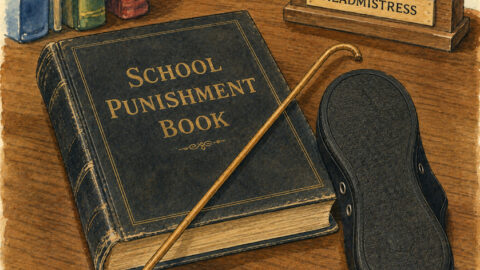
By the early 1980s, corporal punishment in British schools belonged to two worlds at once.
It belonged to the old world because the cane, slipper, ruler and other traditional punishments had not completely disappeared. There were still pupils sitting in classrooms who knew perfectly well that misbehaviour might result in physical punishment.
Yet it also belonged to a new world in which the very idea of teachers hitting children was being questioned as never before.
For pupils living through this period, the change was not necessarily obvious.
Children rarely think of themselves as living through history. If the cane was still being used at your school, it probably seemed irrelevant that another school had abandoned it. What mattered was what happened in your classroom on Monday morning.
Some teachers continued using the methods they had known throughout their careers.
For them, corporal punishment was not necessarily regarded as cruel. It was simply one of the disciplinary tools available to a teacher. They had grown up with it themselves, trained in an education system that accepted it and spent years working in schools where it was considered normal.
Then, almost within a single professional lifetime, the world changed around them.
Practices that had once attracted little comment were increasingly challenged.
Parents became more willing to complain. Educational thinking changed. Children’s rights became a greater part of public discussion. The unquestioned authority once granted to teachers and headteachers was gradually being replaced by rules, accountability and scrutiny.
Corporal punishment therefore entered an uncomfortable twilight period.
It still existed, but its legitimacy was fading.
There was also a growing recognition that the experience of punishment depended enormously upon the individual teacher.
The same gym shoe that one teacher might use relatively mildly could become a far more formidable punishment in another teacher’s hands. The same applied to the ruler, strap or cane.
This raised an unavoidable problem.
A system based upon individual judgement could never produce completely consistent results.
The original recollections demonstrate just how varied those experiences were. One former pupil remembered the slipper being used frequently at junior school and later by a PE master at grammar school, even into the teenage years. Other memories describe girls as well as boys receiving physical punishment, although the methods and severity could differ considerably.
For decades, those differences had simply been accepted.
Now they were becoming part of the argument against corporal punishment.
There was another change taking place as well.
Fear was losing its status as an unquestioned educational virtue.
The old argument had been simple enough: children behaved because they knew what would happen if they didn’t.
But critics increasingly asked whether fear actually taught anything.
A pupil might behave perfectly while a feared teacher was standing nearby and return to misbehaviour the moment that teacher disappeared. Obedience produced through fear was not necessarily the same thing as understanding right from wrong.
The old system had been built upon certainty.
Break the rules and there would be consequences.
By the 1980s, the certainty had moved elsewhere.
Sooner or later, corporal punishment itself was going to face consequences.
The cane had survived changing governments, changing fashions, changing generations and countless educational reforms.
But this time the change was different.
Society was no longer arguing merely about how corporal punishment should be administered.
It was moving towards the conclusion that it should not be administered at all.
The final chapter of an extraordinarily long tradition was beginning.