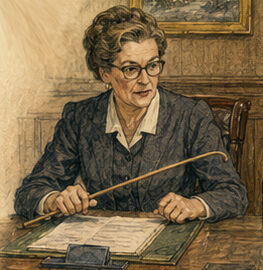
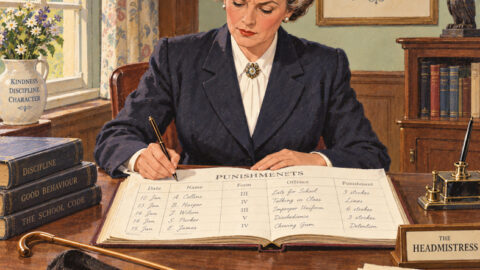
At one English boarding school during the 1960s, only the Headmistress had the authority to administer the cane. Every caning was formally entered into the school’s punishment book, creating an official record of the most serious disciplinary cases.
Looking back, however, those records give a misleading impression of how often corporal punishment was actually used. The Headmistress’s canings were relatively uncommon. In a school of around 800 boys, she probably caned no more than one pupil each day on average.
The day-to-day discipline was carried out very differently.
Other mistresses regularly used the gym slipper, and occasionally whatever implement happened to be close at hand. These punishments were almost never recorded officially. Boys in the lower forms could expect to receive the slipper with remarkable frequency—perhaps twice a week throughout their first four years at the school.
Consequently, anyone relying solely on the punishment book would conclude that corporal punishment was relatively rare, when in reality many pupils experienced it as a routine part of school life.
Looking Beyond the Punishment Book
School punishment books are valuable historical documents, but they are not always the best source for understanding everyday discipline.
School Log Books, kept by the Headmistress to record significant daily events, sometimes provide a much fuller picture. Because they were intended as administrative records rather than disciplinary registers, they occasionally include fascinating details that never appeared elsewhere.
Researchers can spend weeks examining these books without finding anything remarkable, only to discover an entry that vividly illustrates attitudes of the period.
One particularly striking entry reads:
“In spite of warnings the boys arrived at school wet as a result of snowball fights. The whole of Class Two received two strokes on their buttocks and Class Three three strokes. We managed by mid-afternoon to get all the clothing dry for them to go home.”
The wording raises several intriguing questions.
Does “strokes on their buttocks” imply punishment over ordinary clothing, or does it indicate that the punishment was administered on the bare buttocks, as was sometimes the case in certain schools? The reference to drying all the children’s clothing suggests they remained without their wet garments for much of the school day, although the exact circumstances are impossible to determine from the brief entry alone.
Such records remind us how much historical evidence leaves unanswered.
Another log book contains an equally curious entry:
“Following a complaint by two parents, five boys were given three unprotected strokes on the buttocks. The parents were satisfied.”
Interestingly, this punishment does not appear in the official punishment book.
The phrase “the parents were satisfied” is itself open to interpretation. Does it refer to the parents who complained, believing that discipline had not previously been strict enough? Or does it refer to the parents of the punished boys, who accepted the school’s response? Without further documentation, historians can only speculate.
These examples demonstrate that official punishment books provide only a partial record of disciplinary practices in many schools.
A Former Pupil’s Experience
One former pupil recalls a very different experience in a Church of England primary school in Cockermouth, Cumbria, during 1969.
She was eleven years old when she was kept behind after class by her female form teacher for talking during a lesson.
She recalls:
“I was bent over her knee and smacked very hard on my skirt-covered bottom. I remember about thirty hard slaps. It hurt tremendously and at the time it felt very embarrassing and quite indecent.”
She wondered years later whether such a punishment would have been entered into a punishment book, and whether the teacher might have been disciplined for administering it.
The answer is far from straightforward.
Would Such a Punishment Have Been Officially Recorded?
Probably not.
During the 1960s many schools only required formal recording of canings administered by the Headmaster or Headmistress. Lesser punishments—such as the slipper, ruler, strap, or hand—were frequently regarded as part of ordinary classroom discipline and often went entirely unrecorded.
As a result, a punishment involving hand-smacking would rarely appear in the official punishment register, even if it was severe.
Could the Teacher Have Got Into Trouble?
Whether a teacher acted improperly depended upon several factors, including local education authority regulations, school policy, and the standards of the time.
Most education authorities had written rules governing who could administer corporal punishment. Usually these rules concentrated on the use of the cane.
Hand smacking or slippering was often treated rather differently and, in many schools, classroom teachers exercised considerable discretion.
If a teacher who lacked formal authority used the cane, this was generally regarded as an internal disciplinary matter for the school rather than a criminal offence. Typically, the Headteacher might simply grant the necessary authority afterwards or warn the teacher not to exceed her powers in future.
The legal and professional expectations of teachers during the 1960s were very different from those that exist today.
Unless punishment was grossly excessive or there was evidence that it had been administered for sexual gratification, the police would generally not become involved.
Questions That Help Assess Such Cases
Looking back today, several questions help place incidents like this into historical context.
- Were parents aware that this form of punishment was being used?
- Was it something routinely administered to many pupils, or was the child singled out?
- Was the punishment proportionate to the offence?
- Did the teacher appear simply to be enforcing discipline, or was there behaviour suggesting an improper personal motive?
These questions cannot always produce clear-cut answers, but they help distinguish ordinary school discipline, however harsh by modern standards, from conduct that would have been considered unacceptable even at the time.
The Former Pupil Reflects
The former pupil explained that her parents never knew about the punishment.
She doubts they would have approved had they been told, but, like many children of the period, she kept the incident to herself.
She also felt that talking during a lesson did not justify what she experienced.
The punishment consisted of approximately thirty very hard slaps while she was held over the teacher’s knee.
She remembers:
“My bottom was extremely red and sore afterwards. I couldn’t sit down comfortably for quite a while. By the time I got home it was still very pink and hot, although luckily there wasn’t any bruising.”
Because she never undressed in front of her parents, they never saw the effects.
Importantly, she also emphasised that she did not believe the teacher had been touching her in a sexual manner.
“It certainly wasn’t fondling. The smacking was far too hard for that. But as an eleven-year-old girl it still felt very humiliating and quite indecent.”
Was Thirty Smacks Excessive?
Even by the standards of the period, thirty hard hand smacks would have been regarded by many teachers as unusually severe.
Former pupils educated much earlier in the twentieth century have remarked that such a lengthy punishment would have seemed excessive even in the 1920s, when corporal punishment was generally accepted.
What particularly stands out is not merely the use of physical punishment itself, but its duration.
Most classroom hand-smackings involved only a handful of blows. A punishment extending to around thirty strikes suggests an unusually forceful approach to discipline.
The former pupil also recalled that she was by no means the only child punished in this way.
Numerous boys and girls at the school were regularly smacked over the teacher’s knee, indicating that this formed part of her normal disciplinary practice rather than being an isolated incident.