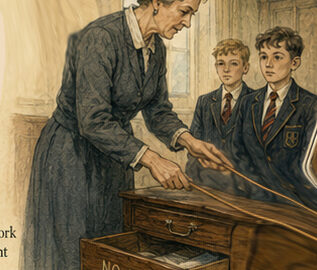
The central justification for corporal punishment was that unpleasant consequences would teach children not to misbehave.
At its simplest the theory was perfectly understandable.
Misbehaviour brought pain.
Pain was unpleasant.
Therefore the sensible child would avoid repeating the behaviour that caused it.
Sometimes this undoubtedly happened.
But human behaviour is considerably more complicated.
The recollections suggest that children could learn many different lessons from precisely the same punishment.
One child learned:
“Don’t do that again.”
Another learned:
“Don’t get caught again.”
A third learned:
“Don’t show the teacher that it hurts.”
A fourth learned:
“This teacher frightens me.”
A fifth might conclude:
“This teacher is unfair.”
And another simply accepted corporal punishment as the price of breaking school rules.
These are very different educational outcomes.
The difficulty with physical punishment was therefore not simply whether it hurt sufficiently to deter a pupil.
The deeper question was whether the punishment helped the child understand why the behaviour was wrong.
There is little in these recollections to suggest that explanation was necessarily central to the process.
The punishment itself could become the lesson.
That may have been sufficient to maintain order.
Whether it was sufficient to develop judgement and self-discipline is another matter.