The last week of October brought with it crisp mornings, drifting leaves and the unmistakable feeling that winter was beginning to settle over the Sussex countryside.
At Highdon, the term had reached its busiest point.
Examinations were only weeks away, the rugby season was nearing its conclusion, and the annual autumn inspection by the governors was fast approaching.
Every corridor gleamed.
Every brass handle shone.
Every classroom seemed even quieter than usual.
Mrs Bellamy walked through Ash House with her familiar smile.
“I know everyone’s working hard,” she said, “but don’t forget that good manners and helping one another are just as important as high marks.”
The younger boys listened carefully.
By now, Highdon no longer felt quite so enormous.
Andrew Collins, once desperately homesick, now knew every path across the grounds and every shortcut between the library and the science block.
Peter Lawson had become one of the school’s strongest rugby players.
Simon Reed spent every spare moment trying to solve the mystery of the tunnel beneath the chapel.
Only David Mercer remained convinced there was still another secret waiting to be discovered.
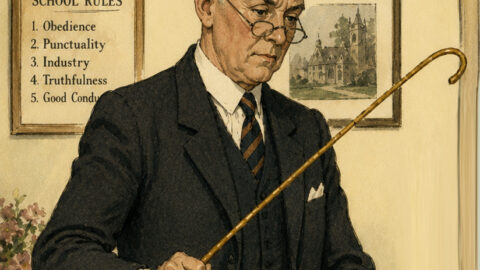
Life at Highdon continued to be governed by long-established traditions. The staff expected punctuality, honesty and respect, and everyone knew the school still retained disciplinary customs that had disappeared from many other schools.
At the centre of it all stood the formidable Headmistress, Miss Bowflower.
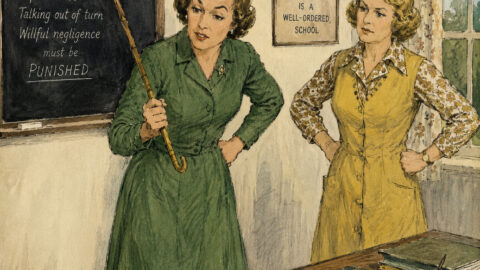
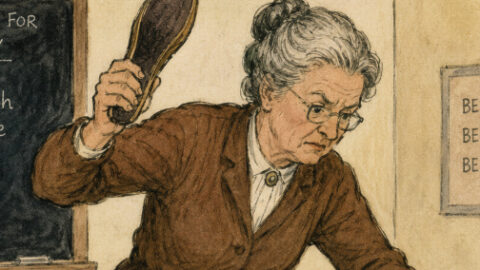
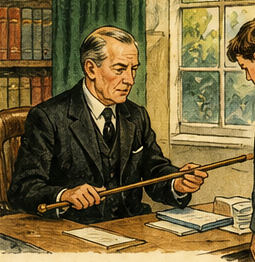
She believed that discipline, fairly administered and never in anger, was an essential part of boarding school life. In the cupboard behind her desk rested a polished school cane, while in the drawer beside it lay a well-worn rubber-soled carpet slipper. Every boy at Highdon knew that either might be used for serious breaches of school rules, although Miss Bowflower never resorted to them lightly. Before any punishment was given, she listened carefully to every side of the story, and once she had reached her decision there was little point in arguing further.
“Discipline,” she often reminded both staff and pupils, “is not about fear. It is about learning responsibility.”
During a staff meeting she looked around the assembled teachers.
“A school earns respect,” Miss Bowflower said calmly, “when its rules are applied wisely, fairly and consistently. Boys should always know exactly where they stand.”
Mrs Fenwick nodded in agreement.
Miss Blyton smiled quietly.
Even Miss Harcourt, whose standards never slipped, accepted that boys responded best when expectations were explained clearly and applied equally to everyone.
That Saturday afternoon, David persuaded his friends to return once more to the old cedar tree.
The diary still rested safely beneath the chapel.
This time they searched farther along the hidden tunnel.
The narrow passage twisted beneath ancient stone foundations before ending at a heavy oak door reinforced with broad iron straps.
“It must lead somewhere,” Peter whispered.
David examined the rusty lock.
“It hasn’t been opened in years.”
Simon lifted his torch towards one of the great timber beams above their heads.
Scratched into the old wood were the words:
For those who seek knowledge, not mischief.
Andrew grinned.
“That sounds more like something Miss Blyton would say than whoever built this place.”
The boys laughed softly, their voices echoing through the darkness.
For a few moments David studied the weathered door.
“I think we should leave it alone,” he said eventually. “Not until we know what we’re dealing with.”
Nobody argued.
Whatever lay beyond seemed to belong to another age.
As they climbed back into the cool autumn sunshine, the chapel bell rang across the grounds.
Its familiar notes drifted between the old stone buildings and across the playing fields.
The boys paused and looked back towards the school.
Highdon was a place where old traditions still lived.
Some were seen every day in classrooms, dormitories and assemblies.
Others survived in forgotten tunnels beneath the chapel.
And a few remained quietly preserved in the Headmistress’s study, where Miss Bowflower’s cane and carpet slipper served as visible reminders that, while kindness was always preferred, deliberate dishonesty, cruelty or persistent defiance still carried consequences.
Whatever secrets lay behind the locked oak door, the boys felt certain they formed part of Highdon’s long and remarkable history.
And history, as Miss Blyton was fond of saying, always rewarded those who approached it with curiosity, patience and respect.