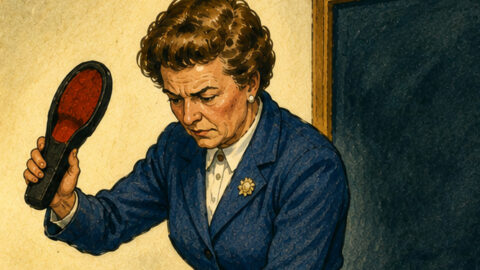
Corporal punishment occupied a significant place in the disciplinary life of many British schools during the years examined in this survey.
For some pupils it was a remote threat.
For others it was an occasional and memorable event.
For a smaller number it became a familiar feature of school life.
The cane, slipper, strap and belt have appeared throughout these pages, but the implements themselves are not the most important finding.
More important are the circumstances in which they were used.
A punishment might follow repeated warnings.
It might result from an impulsive piece of mischief.
It might be imposed for fighting, dishonesty, truancy or persistent failure to work.
It could be administered by an ordinary teacher, senior mistress, housemaster, deputy or head.
It might be witnessed by classmates or carried out privately.
And afterwards the pupil might regard it as entirely deserved, partly justified or completely unjust.
This variety makes sweeping conclusions impossible.
The evidence does, however, challenge several easy assumptions.
Corporal punishment was not necessarily reserved for the most serious offences.
Neither was every punishment arbitrary.
Many schools possessed recognised systems of warning and escalation.
Nor did every pupil resent being punished. Several respondents accepted that they had knowingly broken a rule and believed the consequence effective.
On the other hand, punishment plainly failed in some cases.
Repeated offenders demonstrate its limitations.
So does the pupil whose first experience reduced rather than increased his fear.
Most importantly, punishment depended upon the accuracy and fairness of the adult making the decision.
If the wrong pupil was blamed, or if circumstances were misunderstood, the disciplinary system could turn authority into injustice.
That may be the most important lesson contained in these recollections.
A school requires discipline.
No organised institution containing hundreds of children could function without rules and consequences.
But the quality of discipline cannot be measured merely by its severity.
It must also be measured by consistency, judgement, proportionality and fairness.
The survey has another value.
It preserves something of ordinary school life which official records cannot fully capture.
A punishment book may tell us that a pupil received three strokes in 1964.
It may not tell us that he had been warned repeatedly, that he waited anxiously outside an office, that he returned to class afterwards, that his friends questioned him, or that he remembered the incident many years later.
Those details belong to personal testimony.
They give life to the official record.
At the same time, memory must be treated with caution.
The dramatic survives more readily than the routine.
Dates become uncertain.
Similar incidents merge.
The historian must therefore compare recollection with recollection and, where possible, with documentary evidence.
This book has attempted to do precisely that.
Its purpose has not been to praise corporal punishment.
Nor has it been to condemn every teacher who used it.
The purpose has been to examine a disciplinary practice within the educational world in which it existed.
That world was not uniform.
The strict grammar school, the village primary, the boarding school and the large secondary school could possess very different traditions.
The experience of the pupil consequently depended heavily upon where he or she happened to be educated.
By the early 1970s, questions surrounding traditional school discipline were becoming increasingly prominent.
Whether corporal punishment would continue unchanged could no longer be assumed.
Its supporters could point to pupils who said that one punishment had permanently stopped a particular offence.
Its critics could point to repeated offenders, disputed accusations and punishments which had produced resentment rather than reform.
Both kinds of evidence appear within this survey.
That is as it should be.
A factual study should not select evidence merely because it supports a preferred conclusion.
It should preserve the contradictions.
The final judgement must therefore be measured.
Corporal punishment could deter. It could also fail.
It could be regarded as fair. It could also produce lasting resentment.
It could restore immediate order without necessarily changing long-term behaviour.
Its effect depended not merely upon the punishment, but upon the pupil, the teacher, the offence and the circumstances.
Perhaps, then, the most revealing finding of the Corporal Punishment Survey is not concerned with the cane, slipper, strap or belt at all.
It concerns authority.
School discipline worked best when pupils understood the rules, believed that consequences were predictable and regarded those exercising authority as fair.
Where those conditions existed, even firm discipline could be accepted.
Where they were absent, severity alone could not supply what the system lacked.
And with that observation, this survey reaches its end.