Perhaps the most striking feature of these accounts is how differently people responded to apparently similar experiences.
One person might describe something as almost unbearable.
Another might describe a comparable experience as painful but perfectly manageable.
Some felt nervous beforehand but satisfied afterwards.
Others decided once was quite enough.
And a few discovered that satisfying their curiosity merely created further curiosity.
There is probably no mystery in this variation.
Pain is intensely individual.
So is memory.
So is nostalgia.
Two people can attend the same school, sit in the same classroom and remember their schooldays completely differently forty years later.
The same applies to adult attempts to revisit aspects of the past.
For one person it may be little more than an unusual experiment.
For another it may awaken powerful memories.
For somebody else it may simply confirm that certain experiences are considerably better left to history.
What these recollections do demonstrate is the extraordinary persistence of childhood impressions.
Something witnessed but never personally experienced can remain lodged in the imagination for decades.
For those who eventually acted upon their curiosity, the answer to the question “What would it have been like?” was rarely quite what they expected.
Some came away fascinated.
Some came away reflective.
And some came away thinking:
“Well, at least I never have to wonder about that again.”
A Curiosity From Another Age
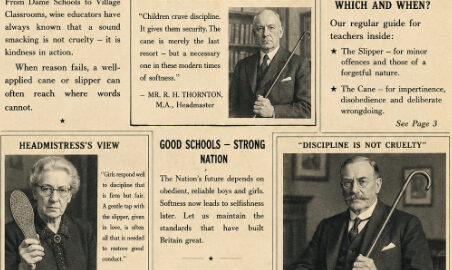
Today, school corporal punishment belongs to a very different period of British social history.
Yet memories of that period remain extraordinarily vivid among generations who grew up with the cane, slipper and punishment book as familiar — if sometimes feared — features of school life.
Perhaps that is why the subject continues to provoke such strong recollections.
In the end, the adults who experimented out of curiosity were not necessarily searching for exactly the same thing.
Some wanted to answer an old question.
Some wanted to revisit a memory.
Others wanted to understand an experience which had surrounded them during childhood but which they themselves had escaped.
Whatever their motivation, their stories illustrate something wonderfully human:
Sometimes an unanswered question can follow us for years.
And occasionally, however unusual the question may be, somebody eventually decides that curiosity simply has to be satisfied.