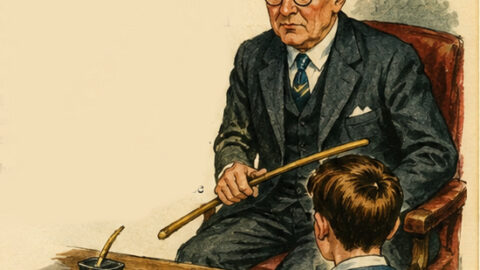
The final question in this section concerns the purpose of punishment itself.
Was corporal punishment intended to correct one specific act, or to reform the pupil’s behaviour generally?
The survey suggests that schools expected both, but achieved them with varying success.
Correcting the Immediate Offence
The clearest measure of success was repetition.
A pupil was punished for running in a corridor.
He stopped running.
A pupil was punished for fighting.
He avoided further fights.
A pupil was punished for talking during silent work.
He remained quiet in future.
On this narrow measure, many respondents considered their punishment effective.
General Conduct
General reform was more difficult.
A boy who stopped fighting might still fail to do his homework.
Another who stopped talking might later be punished for running.
The disciplinary system had corrected a particular behaviour without necessarily changing the pupil’s overall attitude.
The Habitual Offender
For the habitual offender, repeated punishment raises a more fundamental question.
If the same pupil appeared before senior staff again and again, the method was clearly not producing general reform.
The boarding-school respondent repeatedly punished for dormitory offences is an obvious example.
The Well-Behaved Pupil
The opposite could also occur.
A normally well-behaved pupil might receive one punishment and never again appear before senior staff.
Here the punishment seemed decisive.
But even then we cannot know whether the punishment itself caused the improvement.
The pupil might have matured or simply avoided that particular situation in future.
Punishment and Education
This leads to a broader question.
Discipline is not merely about stopping behaviour.
Education seeks to teach judgement.
A pupil who obeys only because he fears punishment has learned something different from a pupil who understands why the rule exists.
Some of the better recollections include a teacher explaining the reason for the rule—for example, the danger of play-fighting on a staircase.
In such cases the lecture and the punishment operated together.
The Limits of the Evidence
The survey records whether former pupils believed punishment effective.
That judgement is valuable.
It should not, however, be mistaken for scientific proof.
Memory, personality and later opinions all influence retrospective assessment.
A Practical Conclusion
The evidence nevertheless permits one firm conclusion.
Corporal punishment could stop a particular form of misconduct.
It could sometimes produce a lasting change.
It could also fail repeatedly.
The result depended upon far more than the punishment itself.
The pupil, teacher, offence, explanation, perceived fairness and wider school culture all mattered.
The instrument was only one part of the disciplinary process.
The success or failure belonged to the whole.