Among English recollections, the slipper occupies a curious position.
It was corporal punishment, but it did not always possess the formality associated with the cane.
The word “slipper” could itself be misleading.
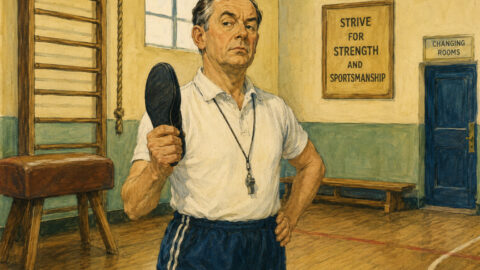
In school recollections it frequently meant a plimsoll or gym shoe rather than an ordinary household slipper.
An Immediate Punishment
The slipper could be readily available.
This was particularly true in the gymnasium.
A physical-education teacher did not necessarily need to send a pupil to the headmaster or obtain a special implement.
The punishment could be imposed immediately.
This convenience appears to have contributed to its use for comparatively ordinary misconduct.
Classroom Use
The slipper was by no means restricted to physical education.
Some respondents remember classroom teachers using it.
One grammar-school contributor distinguished clearly between formal canings, which he could list individually, and classroom slipperings, which he described as numerous and unrecorded.
That distinction is historically important.
It suggests that the slipper could occupy a level of discipline beneath the formal cane.
A 1971 Example
An eleven-year-old pupil at St John’s College, Southsea, recalled talking after the class had been ordered to work silently in 1971.
His form teacher dealt with the matter in the classroom using the slipper.
The punishment consisted of three strokes and was witnessed by the class.
The respondent stated that he did not repeat the offence.
Physical Education
The slipper appears particularly frequently in recollections involving physical-education teachers.
One sixteen-year-old grammar-school boy in 1958–59 received six strokes after being accused of impertinence towards the gym master.
He admitted that he had been cheeky but believed the teacher had exaggerated the seriousness of his behaviour.
Nevertheless, he regarded the punishment as effective.
Formal and Informal Discipline
The slipper therefore illustrates the difficulty of drawing a sharp line between formal and informal corporal punishment.
A six-stroke punishment from a gym master could be a serious event.
A lesser classroom punishment could be almost routine.
Both might be described by exactly the same word.
An Incomplete Record
This is another reason why punishment books cannot provide a complete picture.
The cane used by a headmaster might generate a written entry.
The slipper used immediately by a teacher might not.
Yet from the pupil’s viewpoint both were unquestionably part of the school’s disciplinary system.