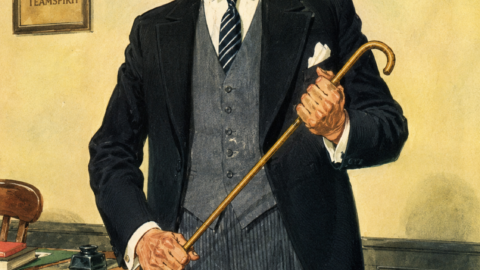
The deputy headmaster or deputy headmistress occupied an interesting position.
Senior enough to possess considerable authority, the deputy could deal with matters beyond ordinary classroom discipline without necessarily involving the Head.
A Second Level of Authority
For pupils, being taken to the deputy head clearly represented escalation.
The matter had moved beyond the classroom.
Yet it had not necessarily reached the school’s highest authority.
This made the deputy particularly suitable for offences regarded as serious but not exceptional.
Running in the Corridor
The 1964 grammar-school account provides a good example.
A twelve-year-old pupil was late for class.
Fearing punishment from his classroom teacher, he began running along the corridor.
He turned a corner and encountered the deputy head.
The attempt to avoid one possible punishment had created another offence.
The deputy head took him to his office and dealt with the matter.
The respondent stated that he did not repeat the offence.
Homework
Another pupil, aged thirteen in 1957, was referred to the deputy headmaster after failing to hand in three sets of homework.
He received a formal punishment but later admitted that he again failed to complete homework.
In this case the deputy head’s intervention was only partly successful.
The Deputy Headmistress
Female deputies also appear in the evidence.
One grammar-school contributor recalled his only primary-school caning, in 1962 at the age of ten, being administered by a deputy headmistress after he had been talking during assembly.
This again demonstrates that senior disciplinary authority was not confined to male staff.
Supporting the Head
The deputy’s role had an obvious practical purpose.
A large school could not refer every disciplinary matter to the headmaster.
Senior staff distributed the burden.
This allowed the Head to remain the ultimate authority while other experienced teachers handled substantial but more routine cases.
Authority in Their Own Right
It would nevertheless be wrong to regard deputies merely as substitutes.
Many clearly possessed established disciplinary authority of their own.
Pupils knew who they were.
They knew what powers they possessed.
Encountering the deputy head in a corridor could therefore alter the course of a school day very rapidly.