As the recollections continued, another pattern slowly emerged.
Although many former pupils remembered girls receiving corporal punishment, they also recognised that attitudes towards disciplining girls were changing. The further the memories moved into the 1970s and early 1980s, the more varied school policies appeared to become.
Some schools continued much as they always had.
Others quietly abandoned physical punishment for girls while retaining it for boys.
Still others moved away from corporal punishment altogether.
These changes rarely happened overnight. Instead, they reflected a gradual shift in educational thinking, with individual schools often moving at very different speeds.
Several former pupils remembered occasions when girls were punished physically in front of the class without anyone considering it unusual. A ruler across the hands, a slipper administered by the class teacher, or a brief punishment before classmates could all take place as part of maintaining order. In these schools, discipline was expected to apply equally to everyone who broke the rules.
Other memories painted a rather different picture.
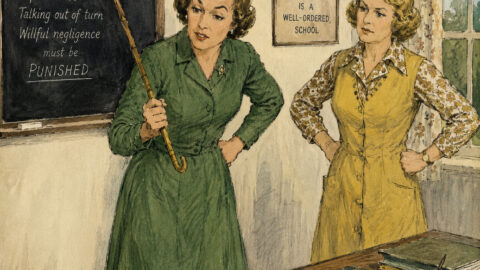
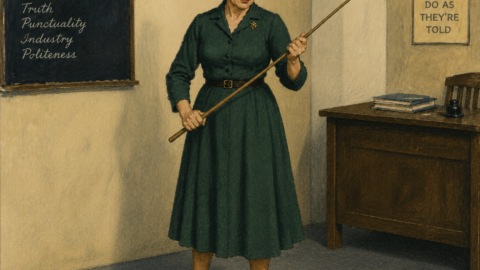
One contributor recalled attending an exclusive girls’ school where strict female teachers regularly maintained discipline within the classroom. According to her recollection, there was nothing particularly remarkable about girls receiving corporal punishment. It was simply regarded as one of the ways in which order was maintained, much as it had been in previous generations. Only many years later did she realise that experiences like hers were becoming increasingly uncommon.
Not everyone accepted these accounts without question.
Several contributors pointed out that practices varied enormously between schools and regions. Some believed that frequent corporal punishment of girls in private schools had been overstated, while others responded by describing their own schools where such discipline certainly had taken place.
Rather than producing a single answer, these contrasting memories illustrated an important historical reality.
Britain never operated one uniform system of school discipline.
Each school developed its own customs.
Each headteacher interpreted regulations differently.
Each member of staff brought their own beliefs into the classroom.
As a result, two children growing up during the same decade could leave school with entirely different recollections of how discipline was administered.
One particularly interesting account came from a former pupil who remembered witnessing several girls receiving the cane together for misbehaving during a lesson.
The punishment itself was relatively light—just a single stroke across the palm of each hand—but what stayed in the memory was the teacher’s attitude.
Before administering the punishment to one girl whose father was also a teacher, he quietly apologised, explaining that she had behaved no differently from the others and therefore had to be treated exactly the same.
The incident left a lasting impression, not because of the punishment itself, but because the teacher appeared determined to be fair and consistent rather than harsh or vindictive.
Looking back today, many of these recollections share one common feature.
Few of the former pupils dwell on the physical discomfort itself.
Instead, they remember the atmosphere of the school.
They remember strict teachers.
They remember clear rules.
They remember classrooms where everyone understood the consequences of persistent misbehaviour.
Whether they approved of those methods in later life varied considerably, but many agreed that discipline was generally viewed as another ordinary part of school life rather than something exceptional.
These memories also illustrate how rapidly educational attitudes evolved during the final decades before corporal punishment disappeared from British schools altogether.
Practices that had once been accepted without question were gradually challenged, modified and eventually abandoned.
Yet because every school changed at its own pace, there was never one single story.
Instead, there were thousands of individual experiences, each shaped by a particular school, a particular teacher and a particular moment in Britain’s educational history.