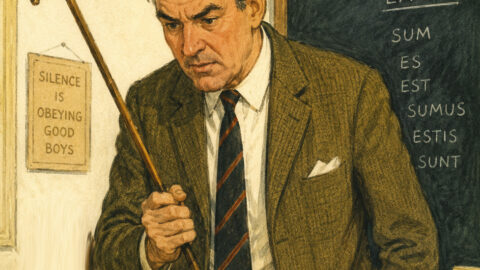
My own memories of junior school in the 1960s illustrate just how normal corporal punishment could appear at the time.
There was one boy in my class who seemed to receive considerably more punishment than anybody else.
He was not what one would immediately have called a terrible child. He did not appear particularly aggressive or troublesome. Yet somehow he was forever being caught talking, fooling around or attracting the teacher’s attention.
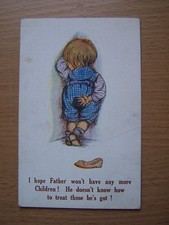
Over the years he received the slipper on numerous occasions and was also sent for the cane several times.
One particular incident remained in everybody’s memory.
The boy was expecting another caning when, for whatever reason, the teacher suddenly seemed unable to continue. In frustration, the cane was thrown aside and the punishment abandoned.
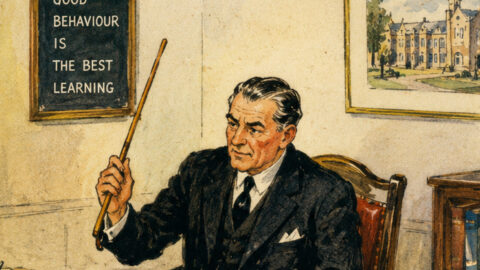
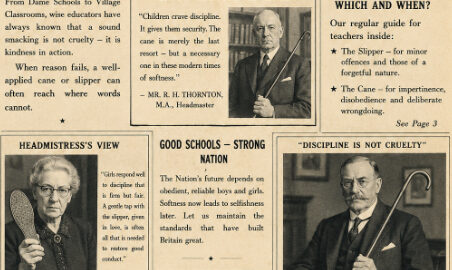
Such incidents seem extraordinary when viewed from the present day, but school discipline was considerably more physical then.
I escaped most of it myself.
On one occasion, several of us were punished for making too much noise. It was embarrassing more than anything else, particularly when you had to return to your place in front of your classmates.
Interestingly, with that particular teacher it was only the boys who received physical punishment.
Why my former classmate was singled out so frequently remains something of a mystery. Perhaps once a child acquired a reputation for misbehaviour, teachers simply noticed him more readily.
Years later I happened to see him working in a fish-and-chip shop when we were both about fifteen. I jokingly asked whether he was still forever getting into trouble at school.
“No,” he replied.
And that was that.
He certainly seems to have done perfectly well in adult life. His name has occasionally appeared in the local newspaper, and he eventually became involved in local politics as a councillor.
It is a reminder that the child regarded as troublesome at eleven does not necessarily become a troublesome adult.
Perhaps that is one lesson from those old schooldays worth remembering.