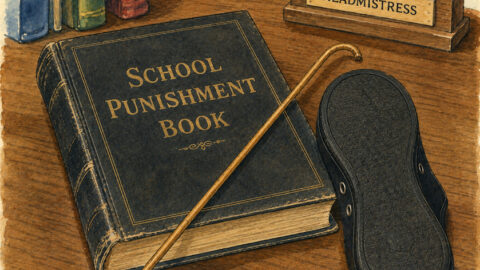
Not all corporal punishment involved the cane.
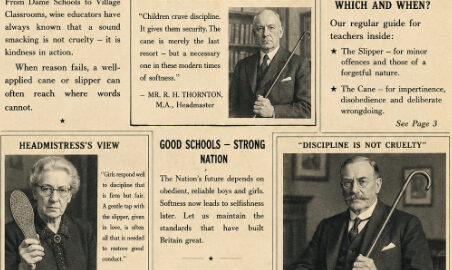
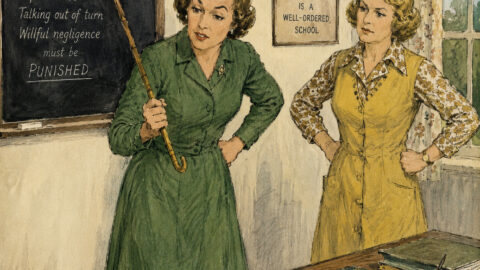
Depending upon the school, the age of the child and the offence committed, pupils might encounter a ruler across the hand, a gym shoe or plimsoll used as a slipper, or the traditional cane. Female teachers administered these punishments just as male teachers did, while in some schools the final decision rested with the headmistress.
One pupil remembered corporal punishment continuing at his school until 1986. He received the ruler from a female teacher in 1982, aged eight, followed by the slipper in 1985 when he was eleven.
By this point, however, many schools were using such punishments far less frequently than earlier generations remembered. A pupil who might once have been sent to the headmistress for a relatively minor offence was increasingly likely to receive a detention, lines or another non-physical punishment instead.
Campaigners, parents and organisations opposed to school corporal punishment had been applying increasing pressure throughout the 1970s and 1980s. Many schools voluntarily abandoned the practice before legislation finally ended it in state education.
Those that retained corporal punishment often restricted its use to more serious misconduct. In some schools, an ordinary female teacher might still use a ruler or slipper, while the cane was reserved for the headmistress and more serious offences.
Family discipline was changing as well.
Physical punishment in the home had certainly not disappeared during the 1980s. Many parents still smacked younger children, while some continued using more formal punishments such as spanking or the slipper. Nevertheless, attitudes were changing there too.
Memories from earlier decades demonstrate just how different things had once been.
One man recalled being slippered in 1953 when he was eleven years old.
His terrible crime?
Forgetting his sports kit.
What remained most clearly in his memory was not the physical pain but the embarrassment.
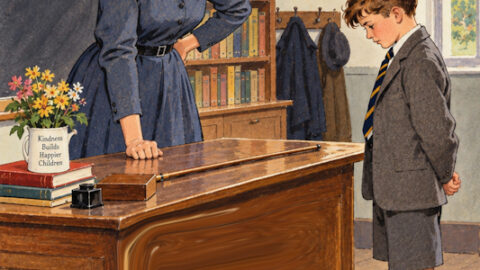
He had to walk to the front of the classroom and bend over a desk while his classmates watched. His female teacher then borrowed another boy’s PT shoe to administer the punishment.
For an academically successful child who normally behaved himself, the humiliation was considerable. He and the girl sharing his two-person desk were among the hard-working pupils sitting at the back of the classroom.
They simply weren’t supposed to be the children who got the slipper.
To make matters worse, the teacher had borrowed the PT shoe from one of his main academic rivals.
For years afterwards, whenever the former victim beat him in a test, his rival had the perfect comeback: he might have lost the test, but at least his shoe had once been used by their teacher to punish the winner!
Curiously, the man could no longer remember how many strokes his teacher gave him or even whether they hurt very much.
Yet another punishment from earlier in his childhood — a smack across the leg — remained vivid decades later.
“Memory,” he observed, could be a curious thing.
Perhaps that tells us something important about school punishment.
What stayed with children was not always the pain.
Sometimes it was being told by a female teacher to walk to the front of the classroom. Sometimes it was the silence of classmates as the slipper or ruler was produced. For more serious offences, it might have been the dreaded walk along the corridor to the headmistress’s office.
Above all, it was often the embarrassment of being singled out and the knowledge that everyone would be talking about it afterwards that remained in the memory long after the physical discomfort itself had been forgotten.