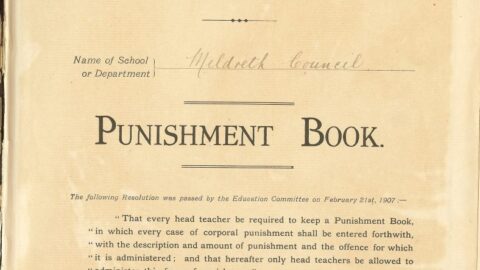
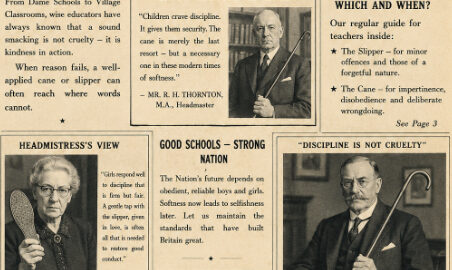
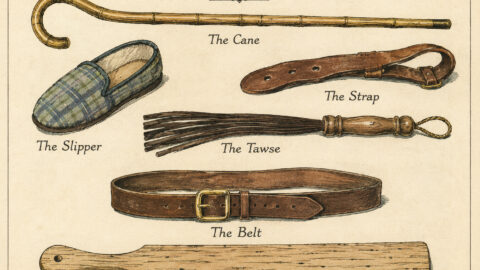
During my years at Maidstone Grammar School (MGS), corporal punishment was certainly part of school life, but despite its reputation, large-scale punishments were actually quite rare. Individual canings for serious offences did occur from time to time, yet the only occasion I ever knew of where several boys were punished together involved four members of my own fifth form.
The incident itself was remarkably foolish rather than malicious. A group of boys had been following one of the male teachers on his way to the dining hall, repeatedly shouting his nickname louder and louder in an attempt to amuse themselves and impress those around them. Unfortunately for them, the teacher in question was Harold P. McCullum, universally known among the pupils as “Merc.”
Merc was a memorable character. He was an excellent mathematics teacher and, in my case at least, deserved enormous credit for helping me achieve a Grade 4 in O-Level Mathematics—a result I would almost certainly never have earned without his persistence and patience. Although he possessed a quick temper when provoked, he was also highly respected for his ability to explain mathematics to even the least gifted pupils.
Born and bred in Somerset, Merc spoke with a wonderfully distinctive West Country accent that made even his reprimands unforgettable.
As the boys continued their increasingly loud chorus of “Merc! Merc!”, he suddenly stopped in his tracks, spun around sharply and thundered:
“Right, you lot—to the Headmasterrr!”
The rolling Somerset “r” only added to the drama.
The consequences were immediate. Three boys who had been actively involved, together with one unfortunate bystander who happened to be standing with them at precisely the wrong moment, were marched straight to the Headmaster’s study. There was no lengthy investigation, no committee meeting, and certainly no appeals process. All four received the cane there and then.
The inclusion of the innocent pupil may seem unfair by modern standards, but schools of the period often believed that swift discipline was preferable to prolonged enquiries. If someone found themselves in the wrong place at the wrong time, there was always a risk of becoming collateral damage.
Merc himself had an entertaining command of the English language. His comments could be both cutting and unintentionally hilarious. One of my personal favourites, delivered when I was struggling with a mathematical problem, perfectly captured both his frustration and his Somerset accent:
“Arr-yew stinkin’ great cabbige, McCook!”
The pronunciation has stayed with me for decades and still makes me smile whenever I remember it.
Looking back, I sometimes wonder whether similar incidents at other schools may occasionally have involved more than simply catching the culprits in the act. If the guilty parties could not all be immediately identified, it would not have been unusual for teachers or the Headmaster simply to gather together those who were present and deal with the matter quickly.
There were, of course, many perfectly ordinary reasons why punishment might occasionally be delayed until later in the day. Some boys could have been away on games, attending lessons elsewhere, or simply absent from the school buildings. Like many grammar schools of the period, MGS possessed extensive sports facilities. We had six rugby pitches of our own, but on busy afternoons fixtures frequently overflowed onto the public playing fields in nearby Mote Park. With pupils spread over such a large area, assembling everyone involved in an incident was not always straightforward.
The Headmaster himself also had a demanding schedule. Administrative meetings, visitors, governors, or inspections could easily delay disciplinary proceedings until a convenient moment. One likes to imagine—purely in jest—that he might even have fortified himself with a discreet sip from a hip flask before confronting a room full of nervous schoolboys, though there is, of course, no evidence that this ever happened.
The prevailing philosophy in many British schools during the 1950s, 1960s and early 1970s was that maintaining discipline sometimes required collective responsibility. When several pupils were involved in disorderly behaviour, the approach could seem remarkably similar to Captain Renault’s famous line in Casablanca:
“Round up the usual suspects.”
Whether entirely fair or not, it reflected an era in which order, authority and swift punishment were considered more important than painstaking investigations.
Life at MGS
The staff at Maidstone Grammar School reflected the educational landscape of the time. The majority of teachers were women, who taught subjects ranging from English, French and history to music, geography and biology. They formed the backbone of the school’s daily academic life and were generally regarded as firm but supportive professionals who expected hard work and good manners from their pupils.
Around one-fifth of the teaching staff were men, many of whom taught mathematics, science, classics, physical education and the senior examination classes. Some, like Merc, developed reputations that lasted long after pupils had left school. Their personalities, accents, favourite sayings and occasionally explosive tempers became part of school folklore.
Despite the occasional use of corporal punishment, most teachers—male and female alike—were dedicated educators whose principal aim was to prepare their pupils for examinations and for adult life. Many former pupils remember them with considerable affection, recognising that beneath the strict discipline lay genuine commitment to their students’ success.
Looking back today, the canings themselves have largely faded into history, replaced by memories of colourful personalities, distinctive characters and the everyday life of a grammar school in an era very different from our own. The incident involving Merc remains memorable not because it was typical, but precisely because it was so unusual: the only mass caning I ever witnessed throughout my entire time at Maidstone Grammar School.