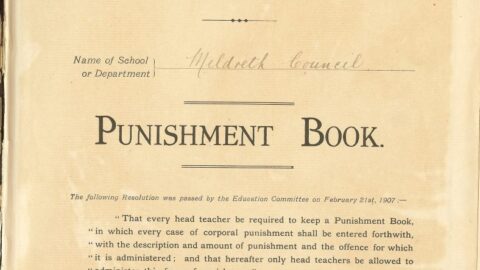
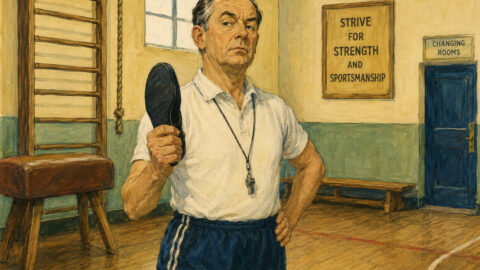
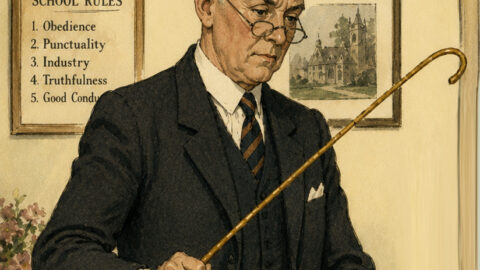
During the 1960s, the authority exercised by prefects over pupils’ conduct beyond the school grounds, together with the severe punishments imposed for commonplace behaviour such as smoking, increasingly came under scrutiny. Doug Eager, School Captain in 1963, became known for administering corporal punishment to boys accused of showing disrespect towards school officers. A letter published in Satura, entitled “Pres and Queues”, criticised the privileges enjoyed by prefects, particularly their practice of moving to the front of queues in the tuckshop. Charles Ream, an American student in 1964, openly declared at a Prefects’ Meeting that he disagreed with the prefect system itself.
More reflective student leaders also began to question the spirit in which discipline was enforced. David Mason, School Captain in 1966, argued that the authority of the Prefects’ Meeting depended upon its exercising power with fairness and restraint. Prefects, he maintained, ought to conduct themselves with dignity and avoid sarcasm or levity when dealing with offenders. He further observed that corporal punishment itself was of less importance than the preceding interrogation and reprimand, and that in some instances the cane need not be used at all.
Doubts concerning corporal punishment grew among the prefects themselves. John McCaughey, in 1964, refused to participate in a caning, while Hamish Ewing, who witnessed one in 1967, later expressed his dismay at the experience. Finlay Macrae, School Captain in 1967, recalled administering punishment with considerable reluctance. One former pupil remembered that his boarding house captain struck him so inaccurately that the blows landed across the backs of his knees and lower back rather than where intended. Although School Captains John Field and Graeme Blanch refrained from caning altogether, the practice resumed during 1970 and 1971.
Corporal punishment administered by staff formally ended in 1988 with the departure of Campbell Stewart, Year 8 Group Master from 1984 to 1988. On the Hill, caning disappeared around 1990. The Prefects’ Meeting itself had largely ceased to function long before then. No meetings were held in either 1973 or 1974, disciplinary matters instead being handled directly by the School Captain and the prefects concerned. The final recorded meeting, in 1975, concerned a boy accused of disobeying a prefect and throwing a dead pigeon at him. The boy admitted the offence, though insisted he had not intended to strike the prefect in the face, a distinction the meeting regarded as inconsequential. He received a Saturday detention.
During the 1960s, changing social attitudes also influenced the prefects’ understanding of discipline. Boys were punished for offences not previously recognised, such as “setting a poor example” to younger students. Others received corporal punishment for accumulating excessive detentions. Cases of insolence towards masters, once dealt with privately by staff, increasingly came before prefects. In 1967, for example, a boy received four strokes of the cane for using “foul and obscene language” towards boys from St Kevin’s across Gardiner’s Creek. The accused maintained that his remarks were neither obscene nor unprovoked, insisting he had merely sought to defend the honour of Scotch. The minutes nonetheless described his conduct during the hearing as “impertinent”.
From 1961 onwards, prefects also identified what became known as “General Attitude”, or “GA”, as a disciplinary concern. Although a state of mind was not ordinarily considered an offence in Australian law, the prefects interpreted poor attitude through outward manifestations such as untidy dress, indifference towards activities including sport or choir, or displays of disrespect. In this manner, they sought not merely to regulate conduct, but also the values and dispositions underlying it. Such attitudes reflected broader institutional concerns that apparently minor details symbolised larger principles of discipline and character.
By 1964 the severity of punishments had somewhat diminished. Only boys involved in serious matters, such as hitch-hiking or bringing firearms or explosives onto school grounds, received more than three strokes of the cane. Moreover, only thirteen cases came before the Prefects’ Meeting that year, compared with forty-nine in 1963. Alternative punishments were increasingly explored. Rowan McIndoe, for example, assigned essays in place of corporal punishment. Yet in subsequent years stricter enforcement of dress regulations and discipline returned under John “Mon” Thomson and David Mason, both boarders, who believed firm standards established at the beginning of the year were easier to maintain thereafter. Consequently, the number of disciplinary charges again increased.
The school regarded itself as an institution devoted to the cultivation of leadership. The gradual disappearance of the prefects’ authority to impose corporal punishment reflected a wider transformation in ideas of leadership itself: away from authority sustained through fear and punishment, and towards leadership exercised through persuasion, example, and moral influence. Such qualities were increasingly viewed as more suitable preparation for future roles in industry, commerce, and the professions, where corporal punishment had no place.
Thus, in 1966, prefects disciplined a boy for “wearing school uniform improperly in a public place, and thereby lowering the name of the school”.
Political awareness among students also emerged during this period. Alan Hartman, in 1970, attempted to organise an anti-Vietnam War protest group at the school in 1968. At the same time, he was caned for what he later described as a comparatively minor disciplinary offence, the only occasion in his six years at Scotch on which he received corporal punishment.
Extracurricular activities flourished alongside these disciplinary traditions. Railway enthusiasts established a club during the 1950s, maintaining approximately fifty members annually. Under the guidance of Dr Mendel, the club organised weekly meetings, film screenings, and excursions. Members constructed a model railway near the rowing pool, rebuilding it in 1965. In 1966, however, one boy was caned for damaging the display.
The prefects’ handling of bullying, by contrast, appeared comparatively lenient. In 1966, a bully received only a one-hour detention, while offences such as smoking or breaches of uniform regulations were still punishable by the cane.
The evolution of leadership at Scotch did not proceed in a simple upward progression, but rather through successive and distinct phases. The school moved from having no formal student leaders, to a small and highly elevated body of prefects, and eventually towards a broader conception of leadership distributed more widely among senior students and consciously cultivated.
At the same time, leadership by personal example remained a constant ideal, though increasingly detached from the power to punish. Over time, persuasion and influence supplanted coercion, while corporal punishment steadily diminished and ultimately disappeared.
What endured longest was not merely a system of discipline, but an inherited state of mind — one sustained for generations through ritual, authority, and, for many years, the cane itself.