I encountered boys from many schools during those years; however, among those within my regular acquaintance, only the boys of Scotch College appeared to display the same intensity of feeling and similar attitudes to those I had known at my own former school.
I must also confess to a degree of institutional pride. I regarded it as a distinction to have attended Xavier College, one of Victoria’s six great schools, and the youngest among them. My interest extends to the history of the other five institutions — Scotch College, Geelong Grammar School, Geelong College, Melbourne Grammar School, and Wesley College — and as Scotch was the earliest established, it seemed an appropriate place at which to begin. Histories of the remaining schools are likewise available to me, and I intend to examine them in due course.
Two brief explanations may assist the reader. “The Hill” refers to the section of the school traditionally occupied by boarders. “Satura” was the title of a student magazine.
The following extracts are drawn from the school’s historical record:
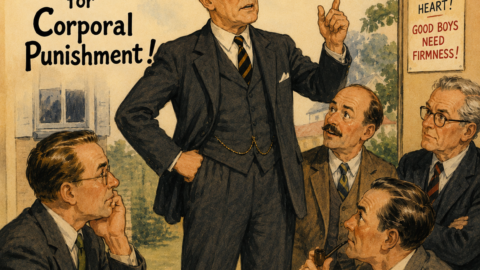
“Various educational models were available to nineteenth-century teachers. The Enlightenment influenced Scotch College’s insistence upon systematic instruction. The Bible’s first example of teaching is that Adam and Eve were given a rule, failed to obey it, and were expelled. Pedagogically this contains two elements: the use of punishment and the use of explanation.”
“Punishment for failure to learn a lesson may vary in severity and purpose. It may be employed as an example to others. Adam and Eve were afforded no opportunity to learn from their error; the lesson was intended for those who followed. It is not accidental that such stern and pre-emptive discipline appears near the beginning of the Bible, and many schoolmasters adopted a similarly formidable approach at the commencement of instruction. Men with military backgrounds had already employed such methods in the armed forces.
“As late as the 1970s, Bond would begin the academic year with a dramatic entrance into the classroom. A heavy ruler brought sharply down upon a desk, combined with an uncompromising demeanour, established authority immediately. Once discipline had been secured, a more relaxed atmosphere might gradually emerge and instruction could proceed. The military philosophy of education was often expressed in the observation that ‘when one fears the instructor more than the task, learning will occur’. By the end of the century, however, Rob McLaren wrote that ‘it is only when a student feels comfortable and secure in his immediate environment that genuine learning can take place’.”
“In the 1920s Edmunds taught writing in the Junior School with what was described as ‘a bunch of keys with which he chastised children’. During the 1930s Charles ‘Chassa’ Pawsey — formidable in both appearance and manner, unsmiling and domineering — employed a rubber hose to punish even minor infractions, including failure to answer questions pupils did not understand. In the 1960s one master reportedly extracted information from boys by twisting small locks of hair until the desired answer was given. Another master was later described by former pupils as ‘sadistic’ and as a man who ‘took pleasure in beating boys’.”
“A more flexible conception of punishment allowed for the possibility that the offender himself might learn from correction. Thus Pharaoh underwent increasingly severe punishments until the required behaviour was achieved, a process in which expectations had been clearly stated from the beginning. The educational principle was that an error should be followed swiftly by rebuke or punishment. This was the method employed by Morrison in the teaching of Latin.
“He required boys to conjugate verbs and decline nouns, and those who failed conspicuously received strokes of the taws upon their open hands. There was no modern leniency about Dr Morrison. The taws was a Scottish leather strap split at the ends. Gordon ‘Gunner’ Owen eventually corrected one boy’s spelling mistakes by threatening him with the cane.”
“Much of the physical punishment appears to have been regarded as entirely unremarkable. Lyne later became friendly with Adams, and together they conducted the school’s branch of the Australian Student Christian Movement. Another former pupil, while repeatedly expressing admiration for Littlejohn, concluded by remarking that he knew him very well because he was frequently caned by him.
“Some maintained that corporal punishment caused no lasting harm and was often treated by boys with humour, whereas detention was regarded as considerably more unpleasant. Morrison himself agreed that a public rebuke could be more painful than a physical beating.”
“For boarders, caning was commonplace. One boy in 1929 was caned twenty-four times within a single term, and on one occasion the cane broke during the punishment. Officially, only the Principal was permitted to administer corporal punishment, and thus caning appears to have been viewed as distinct from the routine physical intimidation that occurred within classrooms.
“It was an age in which a certain level of physical violence between teacher and pupil was widely accepted. A considerable amount of striking and rough handling occurred for no reason beyond habit itself. When the school later relocated to Hawthorn, the buildings were unfinished and two classes were housed in marquees. Littlejohn would walk outside the tents striking any boy whose movement caused the canvas to bulge, and reportedly laughed heartily while doing so.
“Untroubled by later anxieties concerning physical contact, the older inclination to strike boys existed alongside a broader culture of familiarity in which masters might place an arm companionably around a pupil’s shoulders. In the primary years boys learned the alphabet from Miss Hay while seated upon her knee. Even into the 1940s, Gilray might embrace a boy in encouragement. David Grounds, although intending to study Medicine, expressed a wish to pursue English Literature and received from Gilray an impromptu embrace in the middle of the quadrangle.”