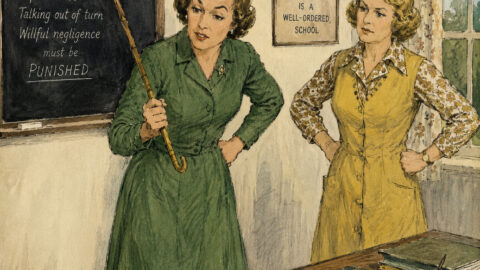
Among my many memories of junior school, one incident stands out as particularly unusual. It involved a boy being smacked by one of the dinner ladies, something that was quite rare even in those days.
The boy in question was a cheerful-looking lad with curly hair who was well known around the school. One lunchtime, while a group of us stood waiting in line to enter the dining hall, a dinner lady suddenly stepped forward, pulled him out of the queue, bent him over, and gave him a quick spanking.
What made the incident especially memorable was what happened afterwards. Another dinner lady, who had witnessed the scene, asked what the boy had done to deserve such treatment. The first lady simply shrugged and replied that he had done nothing wrong, but that she had not smacked him for a long time and thought it was about time he had another one.
The remark was delivered with complete seriousness, although it was received with amusement by those nearby. The boy himself seemed entirely unfazed by the episode. Rather than appearing upset or embarrassed, he accepted it with remarkable good humour and quickly returned to the line as though nothing had happened.
Looking back, the incident seems extraordinary by modern standards and reflects a very different era in school life, when discipline could sometimes be administered in a spontaneous and informal fashion.
My own experiences with the dinner ladies began somewhat differently. During my earliest years at primary school, I normally went home for lunch each day. On one occasion, however, I had to remain at school while my parents attended my uncle’s funeral.
That lunchtime remains surprisingly vivid in my memory. I was served a meal consisting largely of potatoes and beetroot. Individually, I quite enjoy both vegetables, but together they made for a combination that did little to improve my opinion of school dinners. Determined that no food should be wasted, the dinner lady insisted that I finish everything on my plate before leaving the table.
As I slowly worked my way through the meal, I reached what seemed to me at the time a very sensible conclusion: school dinners were dreadful things and should be avoided whenever possible.
For several years I continued going home at lunchtime. Eventually, however, I began to realise that I was missing an important part of school life. While I was away, my friends were spending time together in the playground, playing games, sharing jokes, and enjoying the freedom that the lunch break provided.
Wanting to be part of that social world, I eventually started bringing a packed lunch and staying at school during the midday break. This brought me into regular contact with the dinner ladies who supervised the playground.
These ladies were quite different from those who worked inside the dining hall. In general, they were very popular with the pupils, particularly the younger children and many of the girls. It was a common sight to see groups of children gathered around them during lunchtime conversations.
Most of the dinner ladies were friendly and approachable. They often showed a genuine interest in what the children were doing and would occasionally join in conversations or playground activities. Unlike some teachers, they were not constantly shouting instructions or looking for reasons to tell children off.
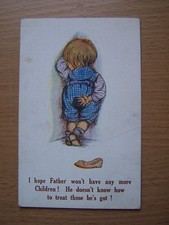
Of course, maintaining order among hundreds of energetic children was never an easy task. The dinner ladies still had responsibilities and were expected to keep discipline in the playground. When children misbehaved, they might threaten to report them to the headmaster, a prospect that was usually enough to restore good behaviour. For lesser offences, a child might be instructed to stand facing a wall for a few minutes to calm down and reflect on their actions.
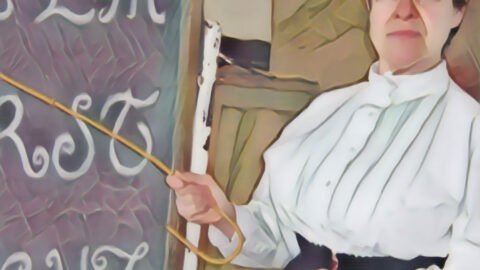
There was one exception to the generally cheerful group. A rather stern and perpetually sour-faced dinner lady seemed to have little patience for children and was noticeably less popular than her colleagues. While most of the supervisors were remembered with affection, she inspired a mixture of caution and avoidance among the pupils.
Looking back, the dinner ladies played an important role in the daily life of the school. They occupied a unique position somewhere between teacher, caretaker, disciplinarian, and friend. They supervised meals, settled playground disputes, comforted upset children, and ensured that lunchtime remained orderly. Although their methods would sometimes seem old-fashioned today, they were an unforgettable part of school life and remain firmly embedded in many childhood memories.